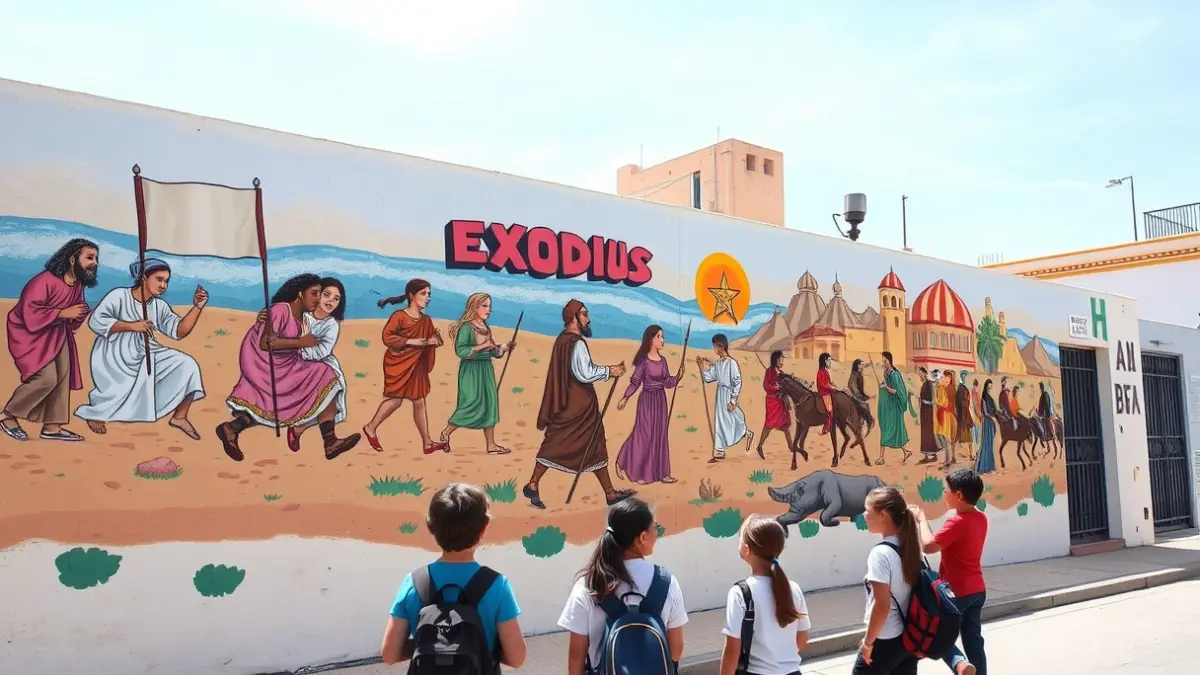
The artwork, installed at the educational center, was presented by the Minister of Culture, Ernest Urtasun, at an event that featured the moving presence of a 92-year-old survivor, who shared her personal testimony of the historical event.
“"With this mural, you convey a message of humanity that is more necessary than ever today. The presence of the survivor gives meaning to everything and alone explains the need to reclaim memory and not settle for silence and oblivion."
The Minister highlighted that the students' creation represents "a lesson for Spain," especially at a time when youth often "show the way" through meaningful initiatives. He emphasized that the students have "used art to tell the story," acknowledging the transformative power of artistic expression in addressing little-known historical episodes.
The survivor recounted her experience, having fled at just three years old and being taken in by another family after getting separated from her own. Her personal story, marked by the need to hide her name to avoid reprisals, illustrates the harshness of those times. She recalled how her mother, upon seeing a reproduction of Picasso's Guernica, exclaimed that "he fled with us," demonstrating the connection between art and collective memory.
Four students, representing the mural's creators, shared testimonies from their great-grandparents who lived through the Desbandá. Their accounts included a great-grandmother's rescue by a stranger, a great-grandfather being taken in by an anonymous family, and a grandfather's memory of witnessing heartbreaking scenes of children and elders during the exodus. The students stressed the importance of ensuring "this massacre is not forgotten" and depicted elements in the mural such as a bomb's crack in a tunnel in La Cala del Moral and the ambulance of doctor Norman Bethune.