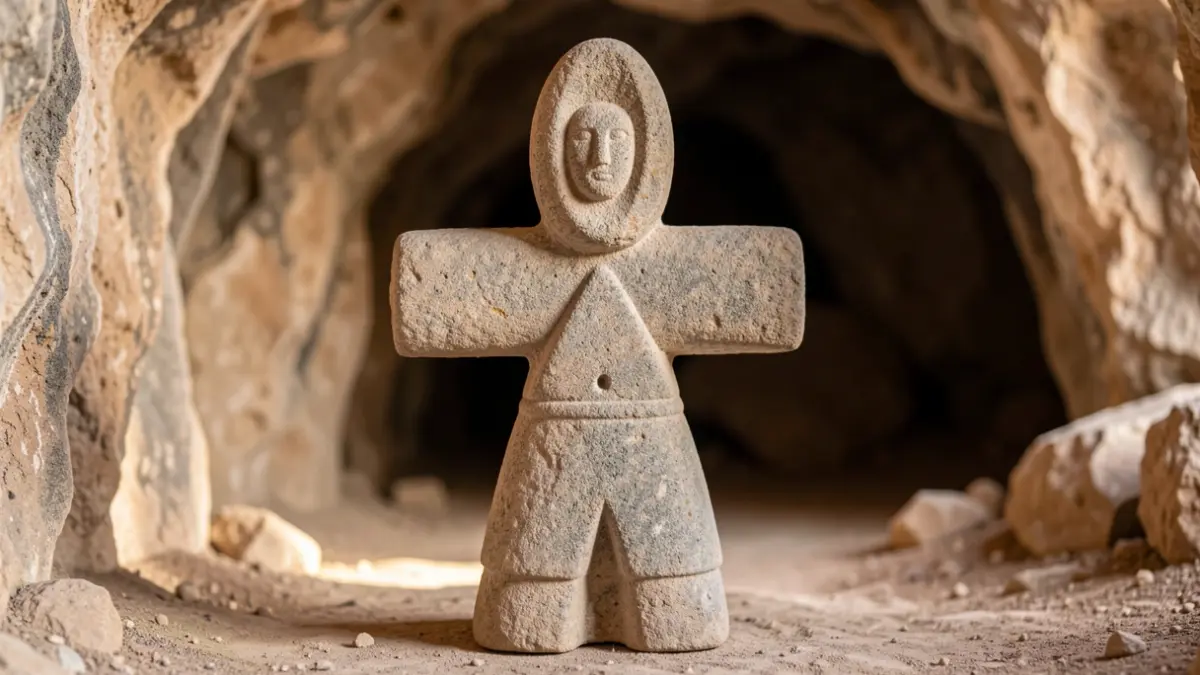
The artifact, dated to the early 3rd millennium BC, was found in the cave at the source of the Cuadros River. The discovery was made under the direction of archaeologist Marco Antonio Bernal, as part of the interventions by the Center for Prehistoric Research of Sierra Mágina.
The territorial delegate for Culture and Sport, José Ayala, visited the exhibition accompanied by Luis Pablo Cañada and Jesús Caballero, representatives of the collective Orgullo Jaén, an entity that sponsors this edition of the initiative.
This cruciform idol, made of limestone using carving and polishing techniques, features a flat front and back with a slightly beveled, cut-out outline. Its morphology includes an oval-shaped head, an upper triangle representing the torso with extended arms, and a lower triangle with a convex base representing a skirt; it lacks features to identify gender.
Cruciform idols are characteristic of the Copper Age in the southern Iberian Peninsula and are related to schematic anthropomorphic representations found in megalithic monuments and rock art, forming an ideological uniformity of prehistoric representations from this period. Although relatively common in domestic and especially funerary contexts of the Andalusian Copper Age, such pieces are scarce in the province of Jaén, which adds significant value to this find.
“"It serves to publicize the deposits of this cultural space and present collections that are not usually shown to the public, supported by non-profit entities with outstanding social work."
Ayala highlighted the value of this periodic initiative by the Jaén Museum, which allows the public to access collections not usually on display, with the support of non-profit organizations.