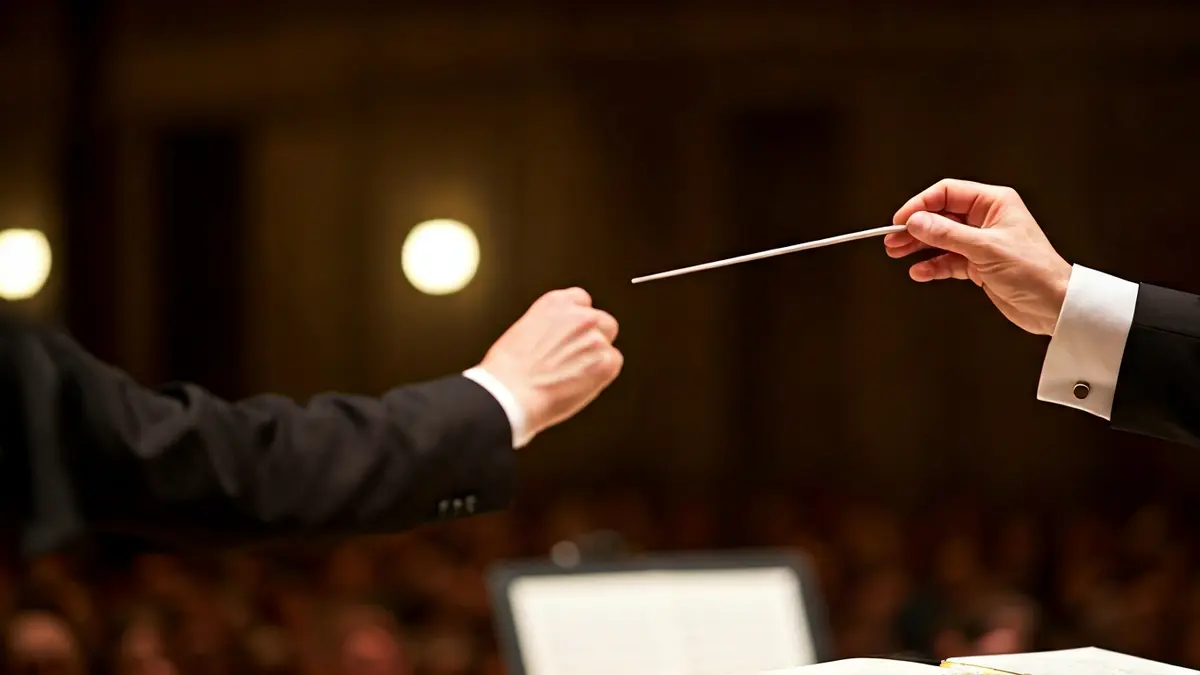
The Orquesta Ciudad de Granada had the privilege of being led by Heinz Holliger, who demonstrated his conducting mastery by extracting controlled and complex sonorities from the ensemble. The program, carefully selected by Holliger, established a dialogue between the classical refinement of Franz Schubert and the constructive tension of Arnold Schoenberg, addressing the transformation of symphonic language at the dawn of modernity.
Holliger's presence in Granada was perceived as a true masterclass. His renowned career as a conductor has focused on clarifying 20th-century musical languages, especially within the Second Viennese School, combining analytical rigor with deep timbral sensitivity. His approach to Schubert, on the other hand, is characterized by a purification of discourse that avoids both expressive overload and stylistic trivialization.
In the first half, Arnold Schoenberg's Chamber Symphony No. 1, Op. 9, performed with an expanded instrumental lineup, revealed the continuity between classical formal heritage and constant variation procedures. The OCG's performance, under Holliger's direction, highlighted the progressive suspension of tonal hierarchy without completely dissolving it, placing the work in the intermediate space Schoenberg inhabited in the early 20th century. The precision of the OCG's soloists showcased the orchestra's high quality.
Schoenberg's Six Little Piano Pieces, Op. 19, in Holliger's orchestral arrangement, concentrated the composer's economy of means and expressive condensation in their brevity. Holliger's orchestration functioned as a mechanism for timbral differentiation, precisely defining each musical gesture and emphasizing the aphoristic nature of these miniatures.
The second half of the concert featured Franz Schubert's Symphony No. 5 in B-flat Major, D. 485, presented from a perspective that emphasized its roots in the classical tradition. The reduced orchestral forces allowed for a light texture and clear melodic lines. The opening Allegro developed with a stable pulse, while the Andante con moto, the expressive core, was approached with restraint, highlighting melodic inflection and instrumental color. The Menuetto and the final Allegro vivace resolved the work with impeccable timbral balance and orchestral blend.
Overall, the interpretation of this eclectic program outlined a play of melodic arcs and contrasting motifs, where the works were presented not as isolated episodes but as moments of a single historical and aesthetic process, making the transformation of musical language comprehensible in its different degrees of explicitness.