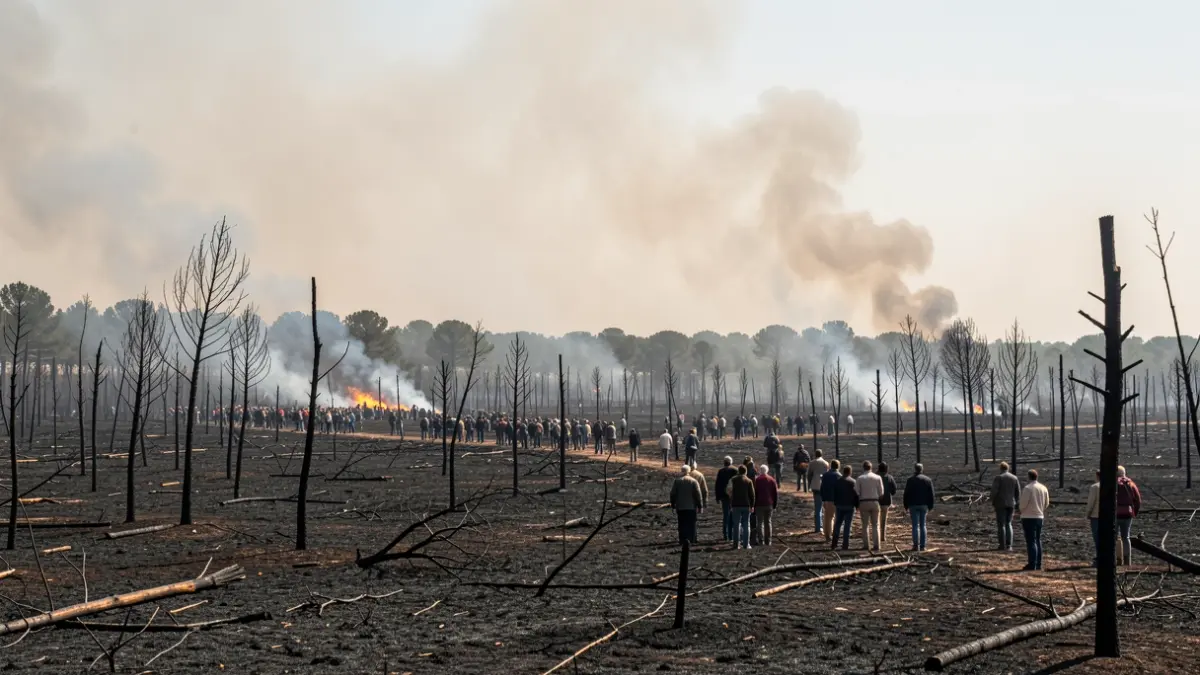
The fire, which continues to rage uncontrolled, has consumed a vast area, ranking among the region's most destructive in terms of extent. Low humidity and wind shifts are hindering firefighting efforts, which involve a large deployment of over 600 professionals on the ground, including members of Plan Infoca and the UME.
The fire's evolution in Huelva province has been concerning since it broke out last Thursday. Friday and Saturday nights were particularly critical due to the flames' expansion, driven by adverse weather conditions. Operational situation 2 of the Andalusian Forest Fire Emergency Plan remained active late Sunday.
Extinguishing efforts have focused on preventing the fire from reaching nearby populations and stopping the wind from spreading the flames to the province of Seville. 605 professionals, 178 material resources, and up to 26 aerial units have been deployed. Sunday's work concentrated on two key defense lines: one in the northern area and another on the left bank of the Tinto River to curb potential spread eastward.
The Minister of Presidency, Health, and Emergencies, Antonio Sanz, described the fire as "unpredictable, dangerous, and complex," warning about the difficulty of predicting its behavior due to wind changes and the generation of secondary outbreaks. The strategy is to consolidate a northern defense line to protect evacuated populations before addressing the eastern zone.
As of Sunday, 474 people remained evacuated from their homes in various locations such as Berrocal, Membrillo Alto, El Pozuelo, Marigenta, Raboconejo, Caballón, Tumbalejo, La Florida, Las Arenas, and their surroundings. The most affected municipalities are Niebla and Valverde del Camino.
The text also contextualizes the Niebla fire by comparing it to other devastating fires in Andalusia, such as the one in Los Gallardos (Almería) in July, which caused 14 fatalities; the Minas de Riotinto fire (2004), the largest of the 21st century with nearly 35,000 hectares affected and two deaths; the Sierra Bermeja fire (Málaga) in 2021, a sixth-generation fire that claimed the life of a forest firefighter; and the Las Peñuelas-Moguer fire (2017), which affected over 10,000 hectares within the Doñana protected natural space.