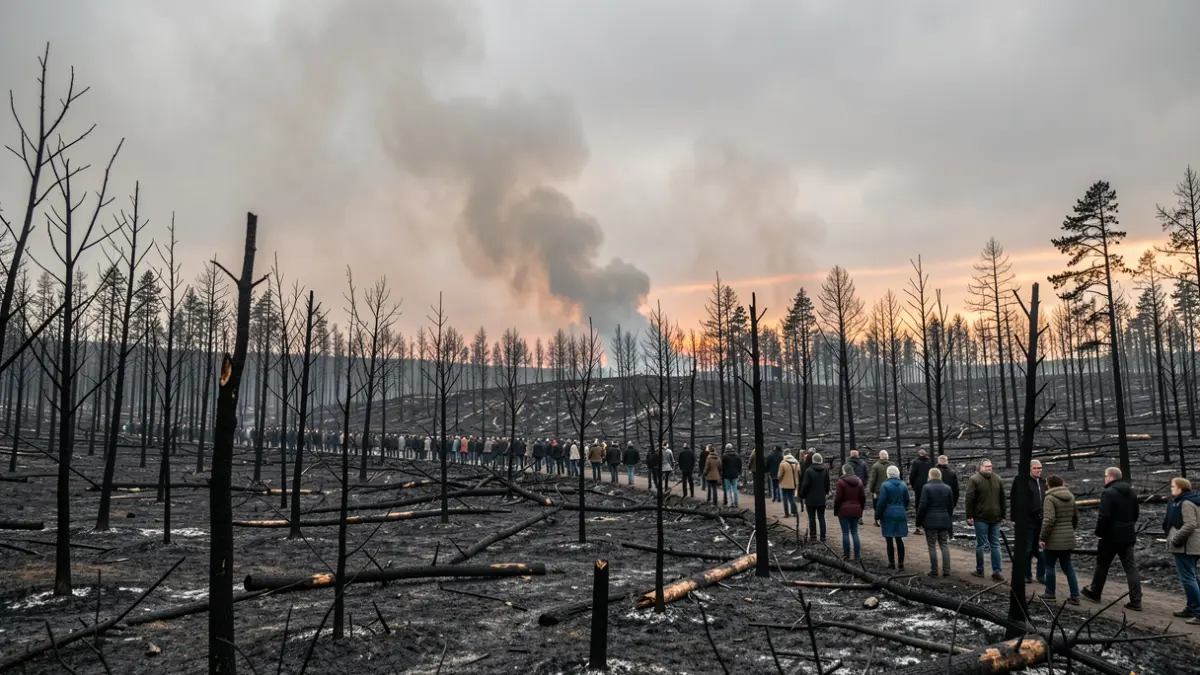
The wildfire in Niebla has left a grey mark of over 38,000 hectares affected so far after one week. This environmental catastrophe has reopened wounds for residents who previously experienced the largest fire in the province of Huelva two decades ago, and who have now been affected again by fire, this time with greater intensity.
With these figures, the fire is now the most severe in the province of Huelva since 1968, according to data from the Ministry for Ecological Transition. To understand its scale, the total area affected by fires and conflagrations in the last eight years was 25,676 hectares. The Niebla fire has burned more land in one week than was recorded across the entire province between 2018 and 2025.
The fire's rapid spread, advancing 12,000 hectares in 24 hours shortly after it broke out, followed by another 6,000 and 3,000 in subsequent days, has surpassed the Minas de Riotinto fire of July 27, 2004, which affected 29,867 hectares over nine days. The latter also impacted areas of Sevilla and led to the evacuation of 630 people, many of whom were the same residents now forced to leave their homes.
The fire has also surpassed the third most severe fire recorded in Huelva, the one in Almonaster la Real in late August 2020, which affected 14,953 hectares in a single day. The municipality of Almonaster la Real has historically been one of the most affected, with a total of 22,332 hectares impacted in major fires recorded by the Ministry.
The municipality of Niebla has become, with this violent fire, the locality with the largest area affected by a large-scale wildfire. Previously, in 2007, negligence caused another fire that affected a total area of 1,028 hectares.
The rapid and virulent spread of the fire is partly attributed to the abundance of eucalyptus trees in the area, according to experts. These trees, intended for productive use, have low-lying branches that facilitate the flames' advance. The accumulation of dry pine leaves also contributes to the fire's rapid spread.