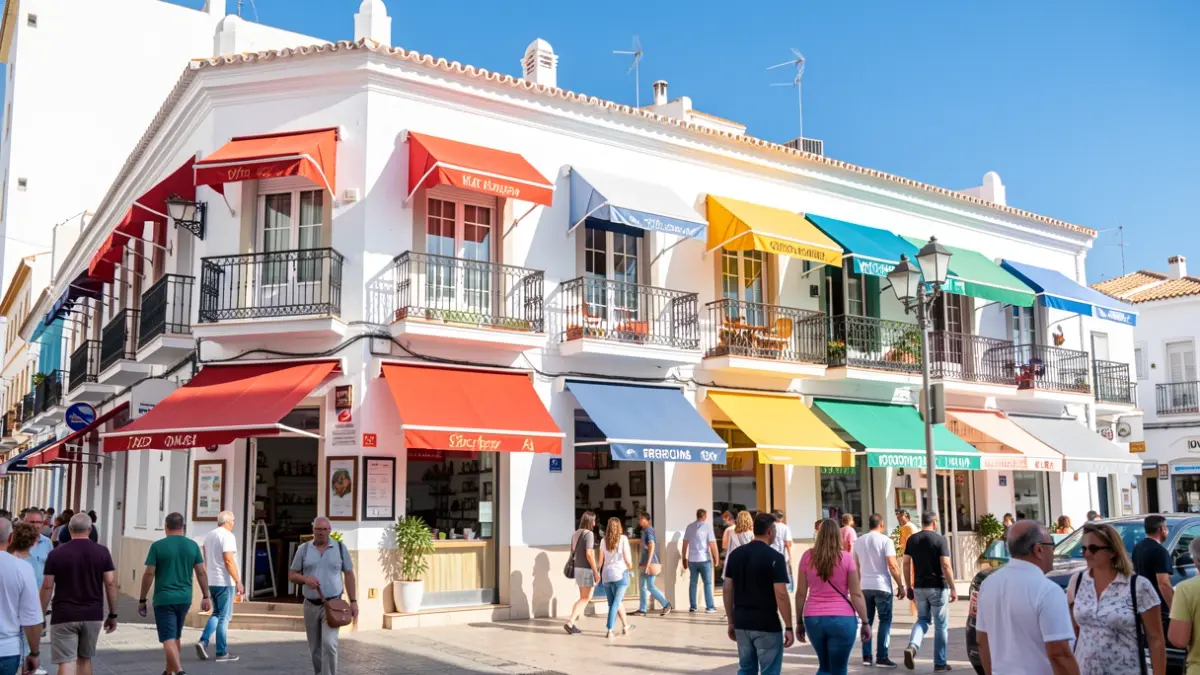
The Torremolinos City Council has unanimously given final approval to the Ordinance Regulating Urban Aesthetics Conditions. This regulation's primary objective is to enhance the city's image, reduce visual pollution, and establish common criteria for the orderly and harmonious integration of facades, businesses, signs, and awnings into their surroundings.
The Councilor for Urban Regeneration, Marina Vázquez, explained during the plenary session that the ordinance is crucial for caring for the city, which is the home of its residents. "Caring for its aesthetics is not a superficial matter. It is a way of caring for our neighborhoods, improving our urban spaces, fostering commercial activity, and offering a more pleasant city to both visitors and those of us who live here year-round," she stated.
The ordinance, the result of significant technical and legal work, has incorporated citizen contributions and those from the municipal group IU-Podemos. Aspects such as clotheslines on facades have been clarified, permitting them only when reasonable alternatives like interior patios or terraces are unavailable. Modifications have also been accepted in articles related to awning, table, and chair advertising to avoid duplication with other ordinances.
Marina Vázquez emphasized that the modifications improve the wording and facilitate the ordinance's application, without altering its essential purpose or objective. "It is not about imposing an aesthetic out of caprice. It is about establishing common rules to protect the image of Torremolinos, enhance our urban identity, and ensure that each intervention contributes to improving the city as a whole," she concluded.
The ordinance regulates aspects such as facade composition, which must present balanced proportions and avoid compositional breaks or the use of discordant colors. Signs must be integrated into the facade design, occupying only the width of the business's opening and located at the top without encroaching on floor slabs or balconies or covering moldings. Intermittent advertising or LED screens in motion are prohibited. Retractable awnings in matte opaque fabric, preferably in solid colors or with discreet stripes, are permitted. Auxiliary installations like air conditioners, antennas, and wiring must be hidden or chromatically integrated.
Special Tourist-Historical Interest Zones (ZEITH) have been designated, including La Carihuela, the historic center, La Nogalera, El Bajondillo, and La Carihuela, which will have additional aesthetic requirements to maintain environmental homogeneity. The ordinance expressly upholds the principle of non-retroactivity, requiring adaptation to the new regulations only for new permits, execution orders, or changes in use or ownership.
In the same plenary session, a declaration motion presented by the PP group in defense of the Spanish sovereignty of Ceuta and Melilla was approved, with the support of IU-Podemos and Vox, and against the vote of the PSOE. The motion expresses support for Ceuta, gratitude to the Security Forces and State Security Corps, and urges the Spanish Government to ensure the recovery of normality and security in the city, as well as to exercise border control and reaffirm Spanish sovereignty.
Two amendments from IU-Podemos were accepted to lament the death of approximately 145 people attempting to reach Spanish territory and to condemn the mistreatment suffered in Ceuta.