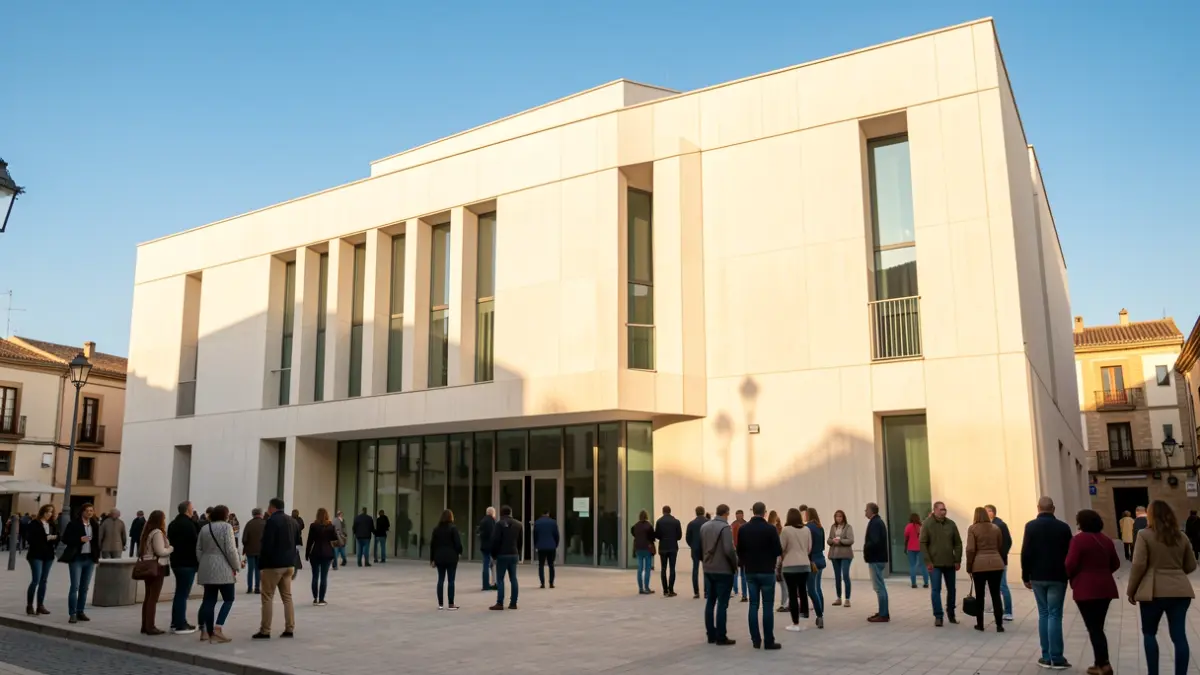
The Centro de Creación Contemporánea de Andalucía (C3A) in Córdoba is commemorating its ten years of activity with the inauguration of the exhibition ‘Ciudad de quién’. This show proposes a deep reflection on the center's trajectory since its opening, its function as an institution dedicated to contemporary creation, and its connection with the environment of Córdoba, Andalusia, and the national context.
Curated by Gilberto González and Lola Baena, the exhibition brings together approximately one hundred works. It is conceived as a “temporary museum” arising from the dialogue between the CAAC's own collection and various pieces loaned by Cordoban lenders. This initiative constitutes the largest exhibition of the CAAC collection outside of Seville and has involved the collaboration of institutions such as the Archaeological Museum, the Museum of Fine Arts of Córdoba, the Filmoteca de Andalucía, the Municipal Archive, the Pepe Espaliú Collection of VIMCORSA, the Bullfighting Museum, the Cathedral Chapter, the Juan Antonio Bernier Collection, the Rafael Carrillo Maestre Collection, the Heirs of José Duarte Collection (Equipo 57), the Joaquín Fayós Collection, the Provincial Council, Nieto y Sobejano Arquitectos, and the Palacio de Viana (Kutxabank Foundation). Additionally, artists such as Ángeles Alcántara, Juan López, Miguel Ángel Moreno Carretero, and Álvaro Perdices have contributed loaned works.
The exhibition also features new productions by Pilar Monsell and Fernando Vacas, created specifically for the occasion. These works explore the presence of the C3A, its active listening, and its responsibility as a cultural institution within the city's urban fabric. The exhibition's design aims to hybridize the idea of a warehouse, opening up to the public and de-hierarchizing the space as originally conceived by the architects.
Rooms T2 and T3 host ‘Genealogies: inhabiting the layers of shared myths’, a journey through symbolic constructions and historical realities. According to Lola Baena, this space intertwines the mythical and the lived, presenting historical works such as the ‘Mosaic of Poets’ or images of ‘San Rafael’ by Juan de Valdés Leal and Damián de Castro, alongside contemporary creations like ‘Drowned Sailor’ by Federico García Lorca, ‘Seated Figure’ by Francis Bacon, and ‘Carrying VII’ by Pepe Espaliú.
Notable is the new work by filmmaker Pilar Monsell, the result of research into the 1652 Bread Riot, highlighting female leadership and the protagonism of working-class women. Fernando Vacas's sound and visual installation on the ‘Campo de la Verdad’ delves into flamenco as a vehicle for intergenerational understanding, exploring the neighborhood's identity.
The Atrium is divided into three thematic areas. ‘Where the City Crosses Time: Why the C3A’ examines the relationship between the building's architecture and its urban context, including the model by Nieto y Sobejano, a 10th-century marble lattice from the Archaeological Museum of Córdoba, and works by artists such as Elena Asins, Ibon Aranberri, Bleda y Rosa, Ana Mendieta, and Manolo Millares.
‘Citizen Cartographies. Visual and Social Narratives of the Territory’ incorporates subjective and social elements, giving prominence to the outskirts and suburbs through images and narratives that invite a rethinking of the city. Pieces by Alegría y Piñero, Lara Almarcegui, Pepe Espaliú, Federico Guzmán, Álvaro Perdices, and Guillermo Pérez Villalta, among others, are part of this section.
In Atrium 1, ‘Who: presences/absences. What is / what could have been’ reflects on the city as a shared stage, bringing together historical posters from the Córdoba Fair and works from the Archaeological Museum and the Mezquita-Cathedral, in dialogue with creations by Pablo Capitán del Río, Nuria Carrasco, Manuel Quejido, Allan Sekula, and Wolfgang Tillmans.
The Contemporary Architecture Foundation presents a space in the Mediateca dedicated to the possibilities of architecture and urbanism, exploring scales of spatial production ranging from the body to utopias.
The exhibition features a wide array of participating artists, including Alegría y Piñero, Allan Sekula, Álvaro Perdices, Ana Mendieta, Ángeles Alcántara, Damián de Castro, Elena Asins, Equipo 57, Federico García Lorca, Fernando Vacas, Francis Bacon, Guillermo Pérez Villalta, Ibon Aranberri, Lara Almarcegui, Manolo Millares, Miguel Ángel Moreno Carretero, Nieto y Sobejano, Pilar Monsell, Pepe Espaliú, Wolfgang Tillmans, among many others.