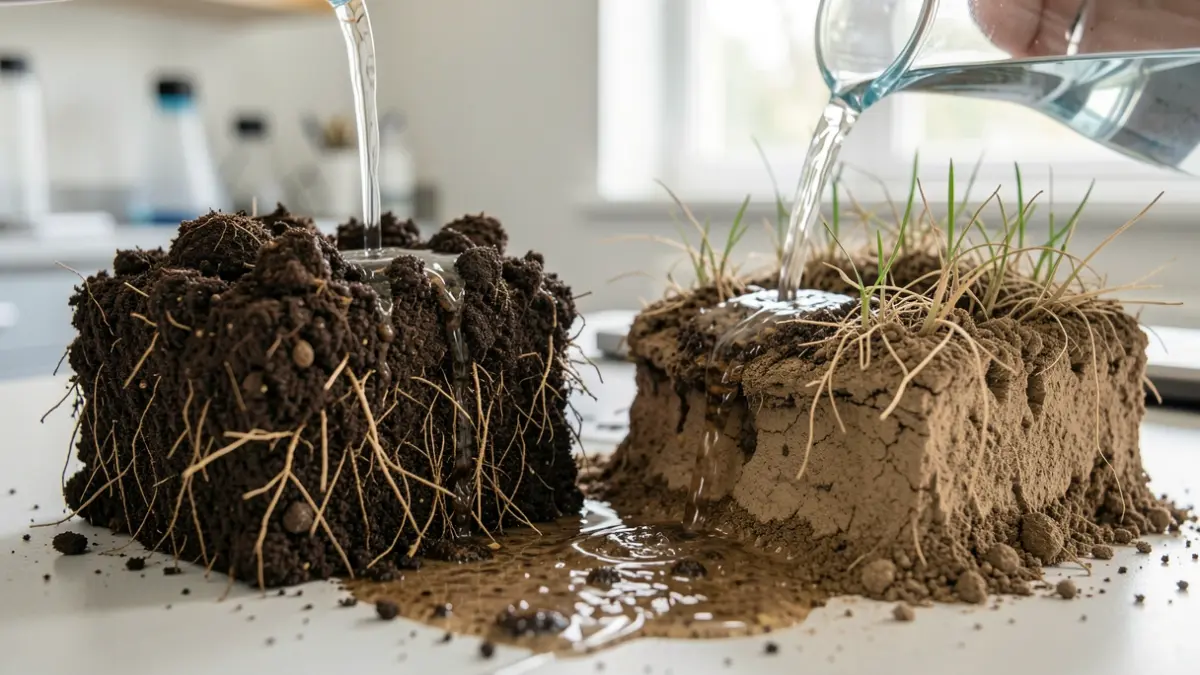
During the Feria de los Ingenios, held last Friday, September 25th, at the Rectorate of the University of Córdoba, researchers from the AGR-126 group presented a visual experiment. Using a water simulator, they compared conventional woody crop management with conservation and regenerative agriculture practices.
The experiment revealed that under conventional practices, a larger amount of water moves across the surface, generating runoff and carrying soil particles. In contrast, models associated with regenerative practices showed greater water infiltration due to soil structure and cover, reducing surface flow.
Miguel Repullo and Francisco Márquez, AGR-126 researchers and participants in the REGEN4ANDALUCIA project, explained that this phenomenon is key for Mediterranean agriculture. The rapid departure of water from the soil surface can cause erosion and affect water quality by carrying away nutrients.
“"What is demonstrated is how regenerative systems greatly reduce runoff and improve water quality, resulting in cleaner, unpolluted water. Therefore, we improve farmers' economies and also provide more ecosystem services with these types of practices."
The REGEN4ANDALUCIA initiative aims to transform Andalusian agriculture through the application of conservation and regenerative practices. The project, which brings together researchers from the five universities of ceiA3 (Almería, Cádiz, Córdoba, Huelva, and Jaén), seeks to find viable and profitable solutions for farmers, connecting soil, water, productivity, economy, and territory.
The demonstration at the Feria de los Ingenios was designed to be accessible, especially for children, turning a complex agricultural phenomenon into a small experiment easily observable by any visitor.