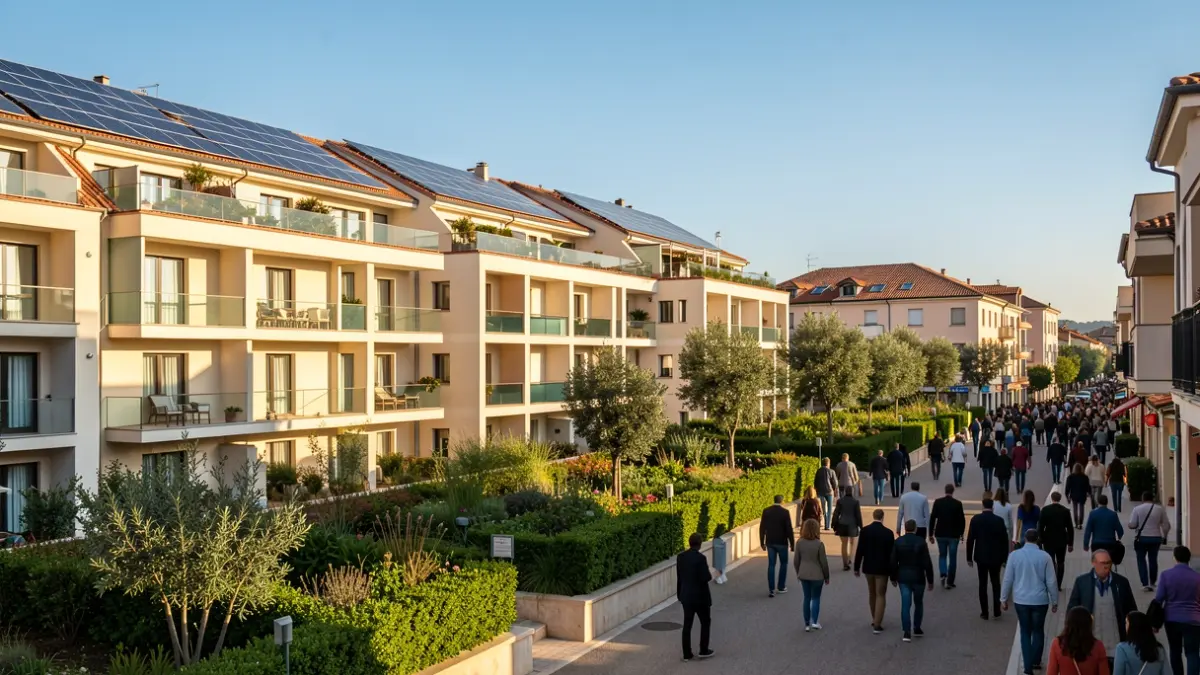
The Seville City Council, through its Urban Planning and Environment Department, is driving the execution of over 7,000 homes, both new constructions and rehabilitations. These actions are part of the sustainability strategy and the European Commission's Climate Mission, in which the city participates.
Integral rehabilitation interventions are focused on 2,000 homes in five priority neighborhoods: Parque Alcosa, Los Pajaritos-Nazaret, Martínez Montañés, Polígono San Pablo, and Huerta del Rey. These projects, with an investment of 20 million euros, aim to improve habitability, energy efficiency, and reduce emissions.
These are complemented by approximately 5,400 new homes, developed in collaboration with EMVISESA and through public-private partnerships, to promote affordable and sustainable housing.
The projects incorporate solutions such as aerothermal energy, photovoltaic generation, and energy self-consumption. The strategy aims for climate change adaptation to directly improve daily life, offering more comfortable homes with lower energy consumption, leading to savings on residents' energy bills.
According to Juan de la Rosa, Urban Planning delegate, all new constructions meet the highest sustainability standards required by the European Union, achieving a double A certification, the maximum rating for energy efficiency and CO₂ emissions.
The delegate also highlighted the city's commitment to the Climate Mission, mentioning the planting of 22,000 new trees and the incorporation of sustainable pavements to mitigate high temperatures and make streets more livable.
The adaptation strategy is complemented by sustainable mobility measures, including promoting public transport, the tram, cycling, and the incorporation of electric buses into the municipal fleet. Additionally, 70% of public lighting has been upgraded to LED technology.
The collaboration between the University of Seville and the Administration has been a transversal element of the Urbanew EMC³ project. Ramón Pico, director of the Higher Technical School of Architecture, emphasized the university's role as a "laboratory at the service of the city."
Carmen Vargas, rector of the University of Seville, participated in a panel on the institution's role in co-creating more sustainable campuses with the City Council.
The Urbanew EMC³ project has received international recognition and was selected for the report «The Road to Belém: The Local Way» by the United Nations, as an example of cooperation among Spanish Mission Cities.