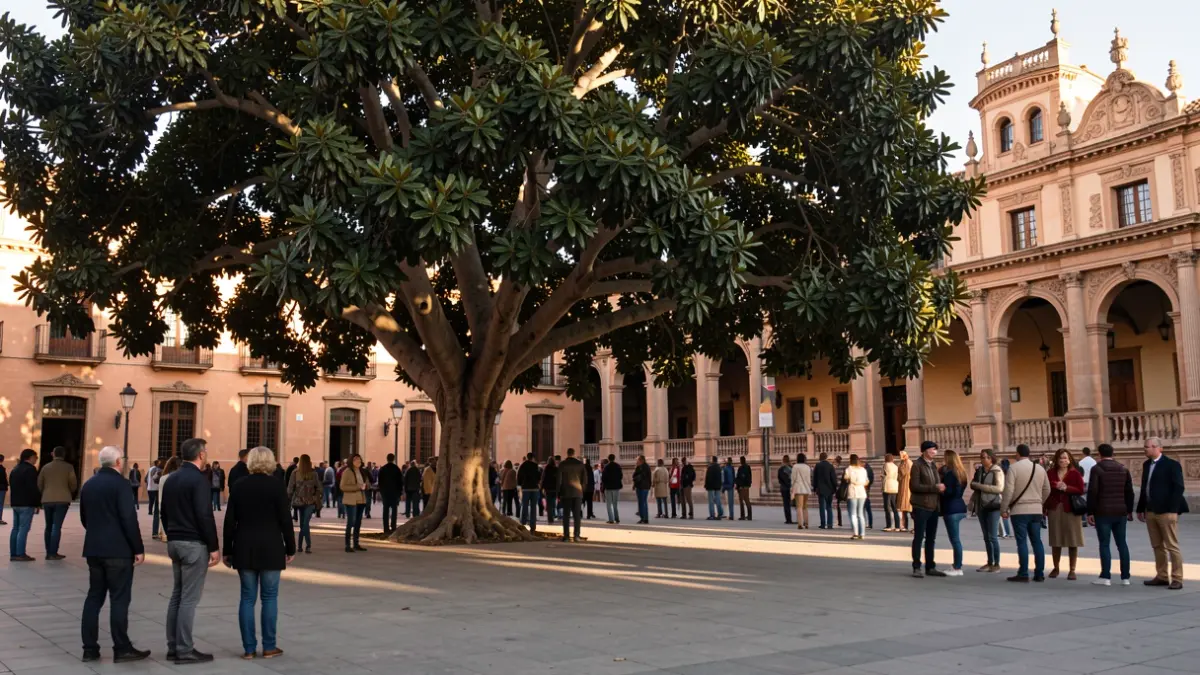
The Andalusian capital joins the second edition of the EUTreeTag 2026 initiative, a European project aiming to raise public awareness about the significance of trees in urban environments, particularly mature specimens. The goal is to make visible the environmental value these trees bring to cities.
A total of 24 Sevillian trees, selected by the Parks and Gardens Service, have been identified with informative labels. These specimens stand out for their characteristics, size, location, and contribution to the community, serving as a representation of the urban tree population as a whole.
The EUTreeTag campaign this year extends to over 1000 trees across 278 European cities. The labels provide simple information about the benefits each tree or group of trees offers, emphasizing their essential role in urban habitability and well-being.
The labels installed in Seville detail the species, dimensions, and canopy area, in addition to quantifying annual ecosystem services such as stored CO₂, oxygen produced, and rainwater retention to mitigate runoff. This data is obtained using the i-Tree tool, employed to assess the environmental services of trees.
“"With this campaign, we want Sevillians to easily and closely understand everything that lies behind a tree. We get used to seeing them as part of the city's landscape, but each specimen provides shade, oxygen, helps regulate temperatures, and retains rainwater."
“"The 24 trees we have selected are just a sample of the enormous value of all our trees. Especially the mature specimens, which have grown alongside the city for decades and today constitute authentic environmental refuges in our neighborhoods."
Among the highlighted specimens is a nearly century-old Ficus macrophylla, located next to the Costurero de la Reina on María Luisa Avenue. Planted in 1929 for the Ibero-American Exposition, this unique tree boasts extraordinary dimensions: a trunk perimeter of over 6 meters, a height of 24 meters, and a canopy exceeding 20 meters in diameter.
This ficus exemplifies the benefits of a mature tree in the city, providing shade, mitigating the urban heat island effect, and improving the environment in a high-traffic area. The species, known as the Australian fig, is characterized by its large foliage, dense canopy, and a robust root system, capable of developing aerial roots.
The specimen on María Luisa Avenue also represents the heritage value of urban trees, having witnessed Seville's evolution and maintaining its landscape and environmental presence despite the surrounding asphalt and concrete.
The campaign includes 19 other trees distributed throughout the city, such as a Mediterranean Cypress in the Seville Cemetery, a London Plane tree in the Jardines Muralla de la Macarena, and a Red Flame Tree in the Jardines del Valle, among others.
The EUTreeTag initiative, promoted in Spain by the Arbocity Association, collaborates with organizations specializing in arboriculture to demonstrate the ecosystem benefits of trees and foster their importance.
The municipal government reaffirms its commitment to preserving Seville's green heritage, disseminating the value of urban trees, and caring for existing specimens, especially mature ones that form part of the city's identity.