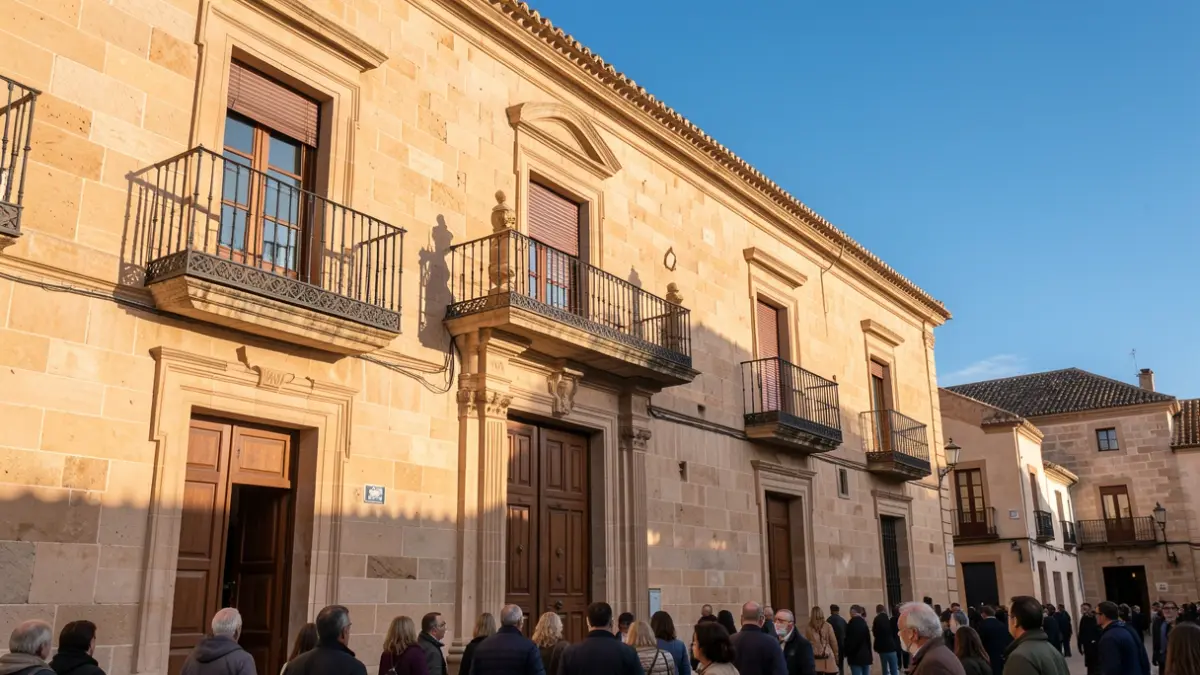
The Plaza de Santa Luisa de Marillac in Jaén was the setting for the institutional event organized for the Andalusian Roma Day, commemorated annually on November 22nd. The event was presided over by the councilwoman for Social Services, Eva Funes, accompanied by the councilwoman for Sports, Beatriz Oñez, and other members of the municipal corporation. Representatives from the Fundación Secretariado Gitano, the association Sinao Kalí, the Provincial Council, and other entities participated.
Eva Funes stated that "Andalusian identity cannot be understood without the contribution of the Roma people, whose culture has enriched music, art, traditions, and social relations for centuries." She advocated that "recognition of this contribution must be accompanied by an effective commitment to equality and coexistence, both in daily life and in the actions of public administrations."
The councilwoman placed special emphasis on education as a "tool to guarantee equal opportunities and prevent any child from having their future conditioned by belonging to a Roma family." She stressed the need to work on preventing school dropout, promoting educational continuity, improving access to employment, and offering support to families in collaboration with organizations working directly with this community.
In this regard, she recalled that the City Council has the I Local Plan for the Roma Community of Jaén 2022-2026, which establishes actions in education, employment, participation, and social inclusion in areas such as La Magdalena, San Vicente de Paúl, Antonio Díaz, the Polígono del Valle, the Bulevar, and San Felipe. The objective is to continue developing measures that improve opportunities for the Roma population, designed with their representatives and associations.
Funes highlighted that this commemoration represents a day of "recognition, memory, and justice towards a people whose history and culture are an inseparable part of the Andalusian identity and the city of Jaén." She valued the work carried out by the Municipal Patronage for Social Affairs through the Program for the Promotion of the Roma Community and the I Local Plan, and particularly emphasized the upcoming establishment, in December, of the Local Council for Roma Participation.
This new body will allow overcoming intervention models designed without the input of their recipients and will ensure that the Roma citizenry has a leading role in policies affecting them. She thanked the involvement of the Fundación Secretariado Gitano and Sinao Kalí, whose experience is fundamental for advancing real equal opportunities, combating prejudice, and strengthening coexistence.
The program organized for this commemoration also included activities aimed at bringing the history and culture of the Roma people closer to citizens, such as an educational initiative involving schoolchildren, a meeting with the La Magdalena neighborhood, a flamenco concert, and a Roma stew-making contest, combining coexistence, gastronomy, and music.