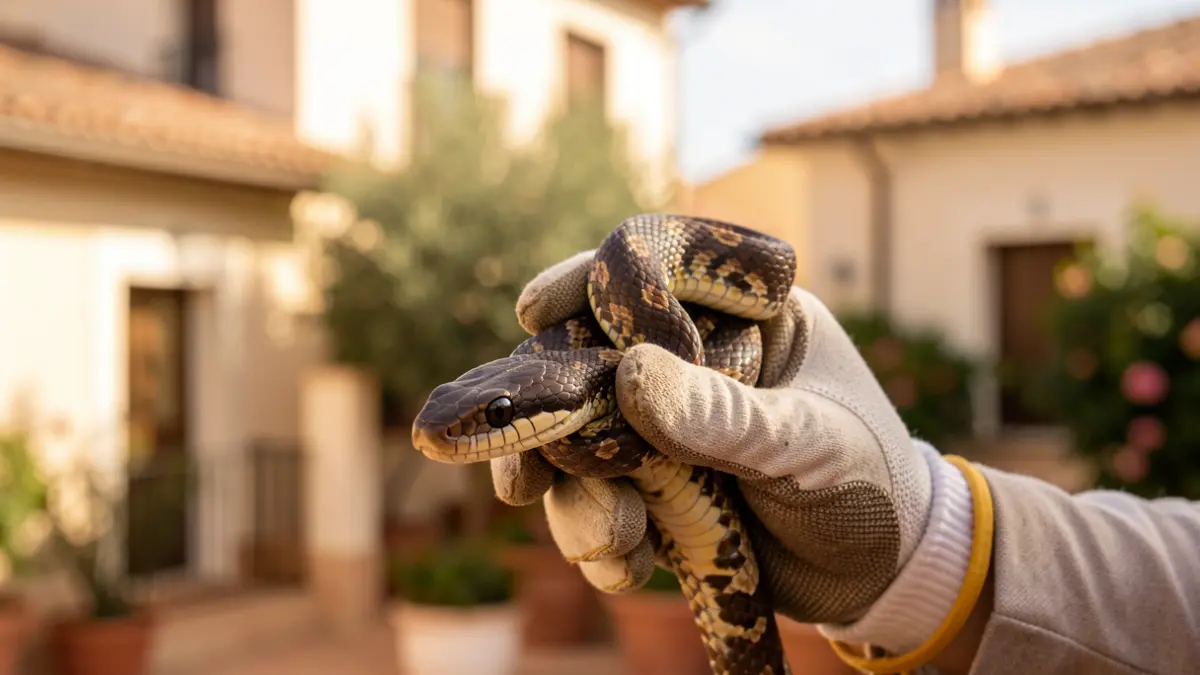
Officers from the Local Police of Castilleja de la Cuesta responded to a report of a snake causing significant distress to residents in a local home. The officers identified the specimen as a Hemorrhois hippocrepis, commonly known as the bastard snake, and proceeded to capture it unharmed for subsequent release into its natural habitat.
According to the official statement from the police force, the intervention proceeded smoothly. "We responded to a home due to the presence of an ophidian, causing great distress to the caller. The specimen was identified as a Hemorrhois hippocrepis (bastard snake), and an officer proceeded to capture it without harm for its subsequent release into its habitat," they explained. The specimen was relocated to an appropriate area for reintegration into the environment.
These types of interventions are increasingly common in municipalities within the metropolitan area of Seville, where the proximity of urban and natural areas leads to occasional encounters with wildlife. Experts advise remaining calm during such encounters and immediately contacting the relevant authorities, avoiding any attempt to handle or capture these animals without proper training.
The bastard snake (Hemorrhois hippocrepis) is a non-venomous snake species native to the Iberian Peninsula and North Africa, capable of reaching lengths of up to two meters. Its scientific name refers to a characteristic horseshoe-shaped marking on its head. It is harmless to humans but may exhibit defensive behavior when threatened. Its diet primarily consists of small mammals, birds, lizards, and other reptiles. It plays an ecological role in controlling rodent populations and is protected by Spanish legislation.
Local security forces in Seville municipalities have specific protocols for wildlife interventions. These procedures include correct species identification, risk assessment, and appropriate measures for public safety and animal welfare. Officers receive specialized training for handling snakes, distinguishing between dangerous and harmless species, and using capture techniques that minimize stress and injury.
When encountering snakes, it is recommended to differentiate between harmless snakes (round pupils) and venomous vipers (vertical pupils). If a snake is found in a garden or home, maintain a safe distance, do not corner the animal, and immediately contact the Local Police, Guardia Civil, or emergency services. Keeping the areas around homes clear of debris and dense vegetation reduces the likelihood of unwanted encounters.
The metropolitan area of Seville boasts rich biodiversity. Castilleja de la Cuesta's location, bridging urban and natural environments, explains the occasional appearance of wildlife like the bastard snake. Balancing urban development with biodiversity conservation presents a challenge requiring territorial planning and environmental education.