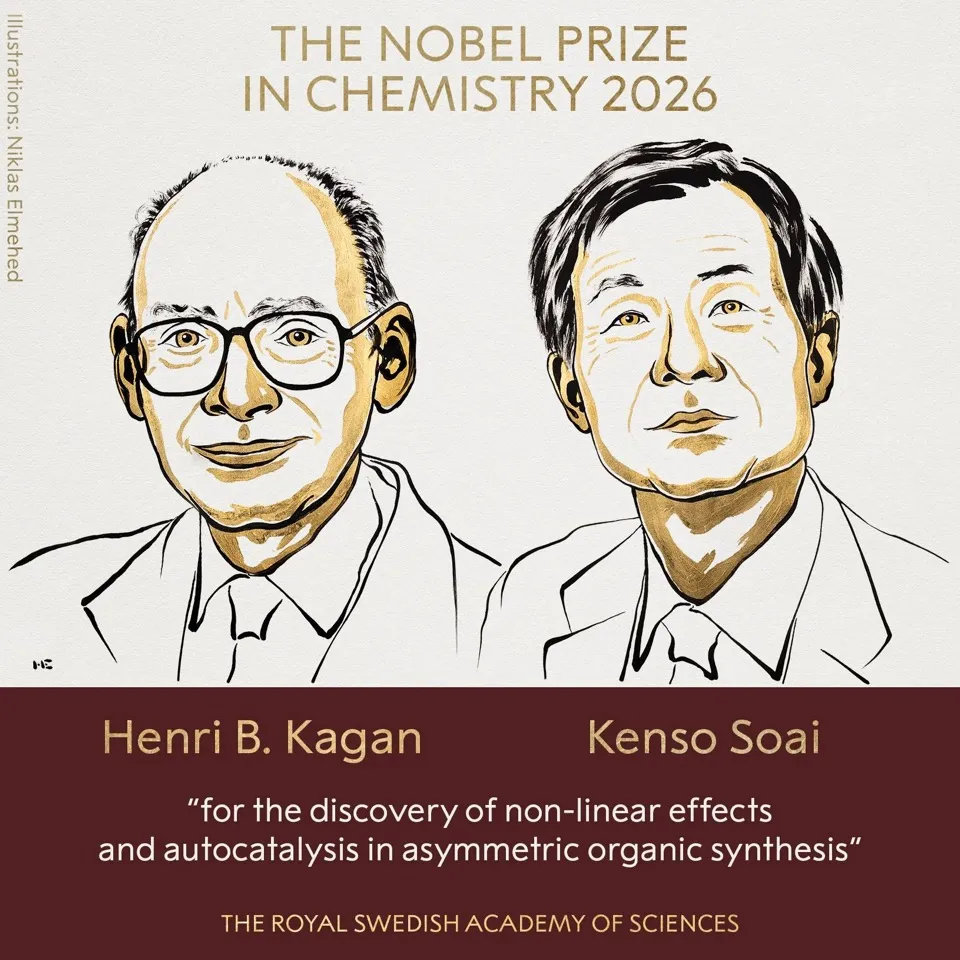
These discoveries explain how a small molecular asymmetry can be amplified to generate systems dominated by a single enantiomer. The announcement marks a long-overdue recognition for Kagan, considered a key pioneer in the field, whose name was omitted from the 2001 Nobel Prize in Chemistry.
Kagan, a major architect of modern asymmetric synthesis, developed DIOP in 1971, a chiral diphosphine that established the principle that ligand symmetry and geometry could control enantiomer production. His contributions also include the asymmetric synthesis of chiral sulfoxides and the introduction of the Kagan reagent (samarium(II) iodide, SmI₂).
In 1986, Kagan demonstrated nonlinear effects, showing that a slight difference in a catalyst's enantiomeric composition could lead to a much larger difference in the product, thereby amplifying chirality.
Kenso Soai further advanced this principle in 1995 with a reaction of asymmetric autocatalysis, where the chiral product itself catalyzes its formation, amplifying an initial imbalance.
The significance of these findings extends beyond organic synthesis, connecting to the homochirality of biological molecules essential for life, such as amino acids (L-series) and sugars (D-series). Kagan and Soai's work demonstrates how an initially minuscule asymmetry can be chemically amplified, offering insights into the origin of this chiral preference in early Earth.