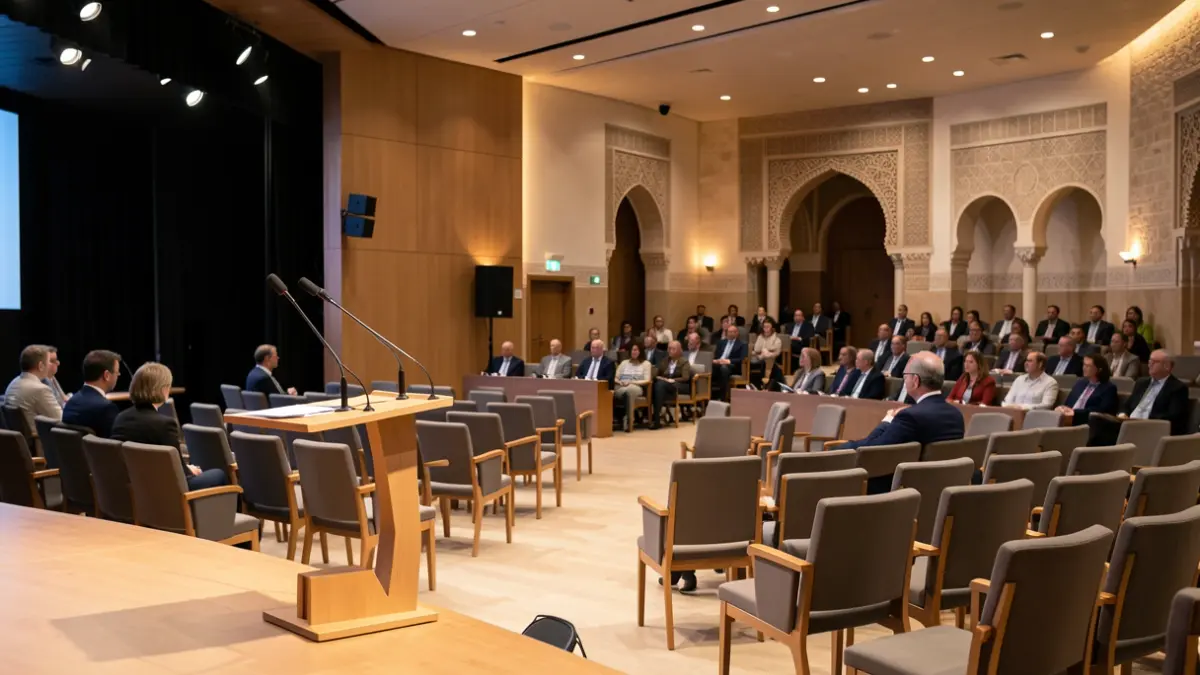

The European Union is at a crucial moment in the debate on asylum law and migration flow management, marked by the approval of the new European Pact on Migration and Asylum. In this context, the University of Almería has hosted specialized conferences to examine the repercussions of these regulatory reforms on human rights protection and on community and social reality.
The event, jointly organized by the European Documentation Centre of the University of Almería, the Vice-Rectorate for Scientific Policy of the UAL, the Centre for the Study of Migrations and Intercultural Relations (CEMyRI), and the Area of Public International Law of the Faculty of Law, with the collaboration of the Vice-Rectorate for Students and the EUPROTEGE research project, featured legal and social experts. The inauguration was led by José Ignacio López-Gay, director of the European Documentation Centre of the UAL; Eva Díez, titular professor in the area of Public International Law at UAL; and Ángeles Arjona, director of CEMyRI.
José Ignacio López-Gay highlighted the importance of the migration issue, especially for Almería, the fourth city with the largest migrant population in Spain. The aim of the conferences is for the more than 150 participants to gain greater knowledge of European policies in this area, bringing together professionals from the legal and socio-anthropological fields to debate the new pact.
In the legal analysis, Juan Santos Vara, professor of Public International Law at the University of Salamanca, addressed the situation at the Ceuta border, suggesting a possible instrumentalization of immigration by Morocco for political purposes. He lamented the lack of a unified response from the European Union and the absence of solidarity and aid mechanisms for Spain, noting that internal political polarization and the management of unaccompanied minors have hindered the implementation of solutions.
Joana Abrisketa, professor of Public International Law at the University of Deusto, detailed the architecture of the new European Pact on Migration and Asylum. While its formal purpose is to harmonize asylum procedures and foster solidarity among member states, she warned that an underlying intention is migrant control, detention at borders, and the establishment of internment and detention centers.
The conferences will continue tomorrow, Friday, with the participation of experts such as Carmen Gregorio, professor of Social Anthropology at the University of Granada, who will address the migratory situation in Ceuta from a feminist gender perspective, criticizing the instrumentalization of the notion of culture and the representation of migrant women. She will emphasize the urgency of intercultural dialogue and the weight of the migrant population in economic sustainability and the care sector.