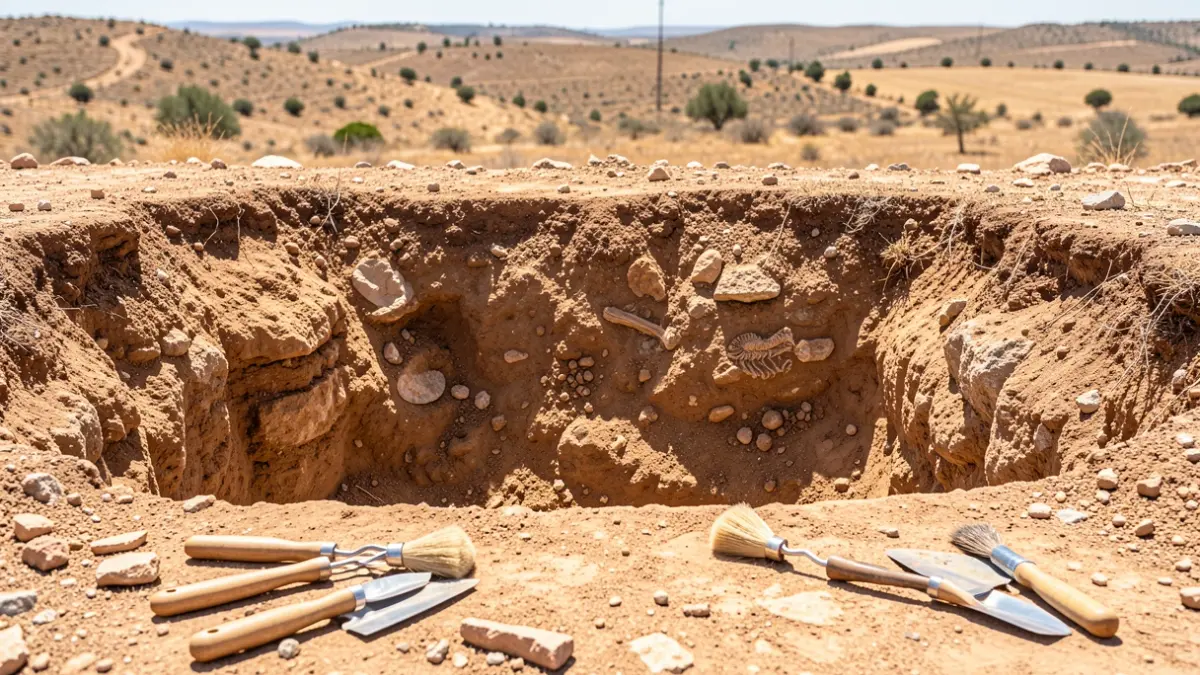
The Baza City Council has renewed its exclusive funding for this intervention, reaffirming its commitment to the development of this paleontological site. The current campaign is part of the General Research Project for the study of the Pliocene of the Baza Basin, authorized by the Regional Ministry of Culture and Sports of the Junta de Andalucía. Preparatory work at the site was carried out in the days prior to the excavation.
Paleontologists Bienvenido Martínez, the local Sergio Ros-Montoya, and Antoni Canals are leading this tenth campaign. The team consists of 28 people: 14 students from universities such as Florence, Pisa, Autonomous University of Barcelona, Málaga, and Almería, along with 14 members of the scientific team from institutions like the University of Málaga, ICREA-IPHES-Rovira i Virgili University, ICP-Autonomous University of Barcelona, Complutense University of Madrid, University College Cork (Ireland), NOVA University of Lisbon (Portugal), and the Museum of Jerez de la Frontera. The team includes geologists, paleontologists specializing in taphonomy and mammal/microvertebrate systematics, documentation archaeologists, and a fossil restorer.
During this campaign, the excavation cut will be significantly expanded, particularly in the southwest sector, to access lower levels rich in fossils, especially in stratigraphic unit 2. A substantial amount of earth will be moved to excavate and extract important paleontological records. Concurrently, excavation will continue in the upper levels of Stratigraphic Unit 5, where remains of mastodons of the species Anancus arvernensis are abundant.
The Baza-1 paleontological site, dated 4.5 million years ago, is located on the Cuesta del Francés, near the Baza Fault, and was discovered in May 1996. Over 55 square meters have been excavated to date, revealing levels rich in macrovertebrate fossils. Approximately 3,250 fossil records have been extracted, including remains of primitive elephants (Mammut borsoni and Anancus arvernensis), rhinoceroses, three-toed horses (hipparions), small pigs, ruminants, the giant bear Agriotherium, other carnivores, 16 species of small mammals (including African rodents like Paraethomys baeticus), birds, reptiles (notably turtles), amphibians, fish, and plant remains.
The presence of the last crocodiles in Europe at the site indicates tropical/subtropical climatic conditions during the Pliocene. This data positions Baza as one of the most important Pliocene sites in Europe, crucial for understanding the Iberian Peninsula after the Messinian salinity crisis and the subsequent opening of the Strait of Gibraltar.
The scarcity of Pliocene sites with large vertebrates in Europe makes Baza fundamental for understanding this geological period. The quantity and quality of its fossils provide a unique record on the continent, solidifying the site as a gem of the Granada GEOPARK.