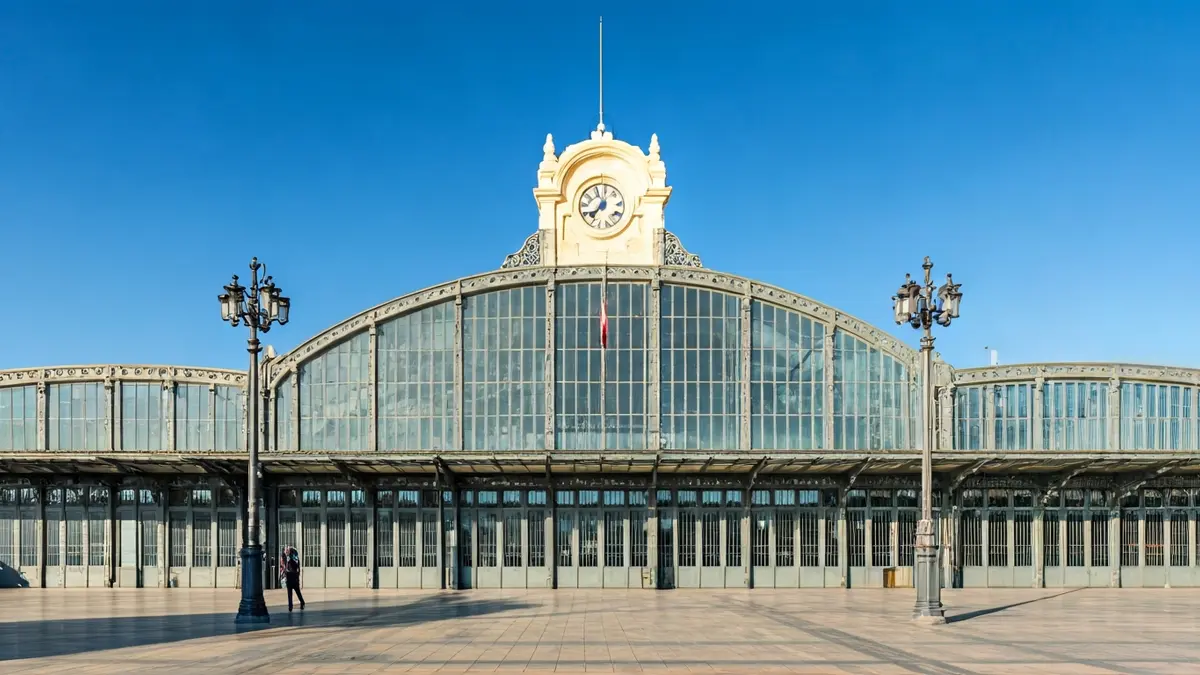
Inaugurated in 1895, the station stands as one of the most unique buildings in the capital of Almería, notable for its iron structure and large glass surfaces. Its design links it to other major European stations of the era, such as Atocha Station in Madrid or Estación del Norte in Valencia, although its recognition has largely remained local.
A remarkable detail of its interior was the installation of a clock by the prestigious French watchmaker Paul Garnier, known for supplying timekeeping systems to numerous stations and public buildings across Europe during the 19th century. The building's design is attributed to the French engineer Laurent Farge, associated with the Compañía de los Caminos de Hierro del Sur de España, who conceived a symmetrical composition that maximizes natural light and spatial amplitude.
The origin of this infrastructure was not passenger transport, but the need to move mineral from the province's interior, specifically from Alquife, to the port, connecting directly with the Cable Inglés. Mining was the economic engine that drove its construction at a time when Almería was the last Andalusian capital to have a railway connection, after years of failed attempts and funding problems.
For over a century, the station was a crucial hub for both freight and passenger transport. However, in the early 2000s, the opening of the intermodal station relegated the historic building to a secondary role, drastically limiting its activity. Beneath its foundations, access points to Civil War shelters have also been discovered, part of the underground network built to protect the population from bombings.
Currently, with the imminent arrival of high-speed rail, the future of Almería's old station remains undefined. Various options are being considered, such as its transformation into a cultural space, its partial integration into the new railway system, or a more ambitious rehabilitation, with no concrete decision yet made regarding its definitive function.