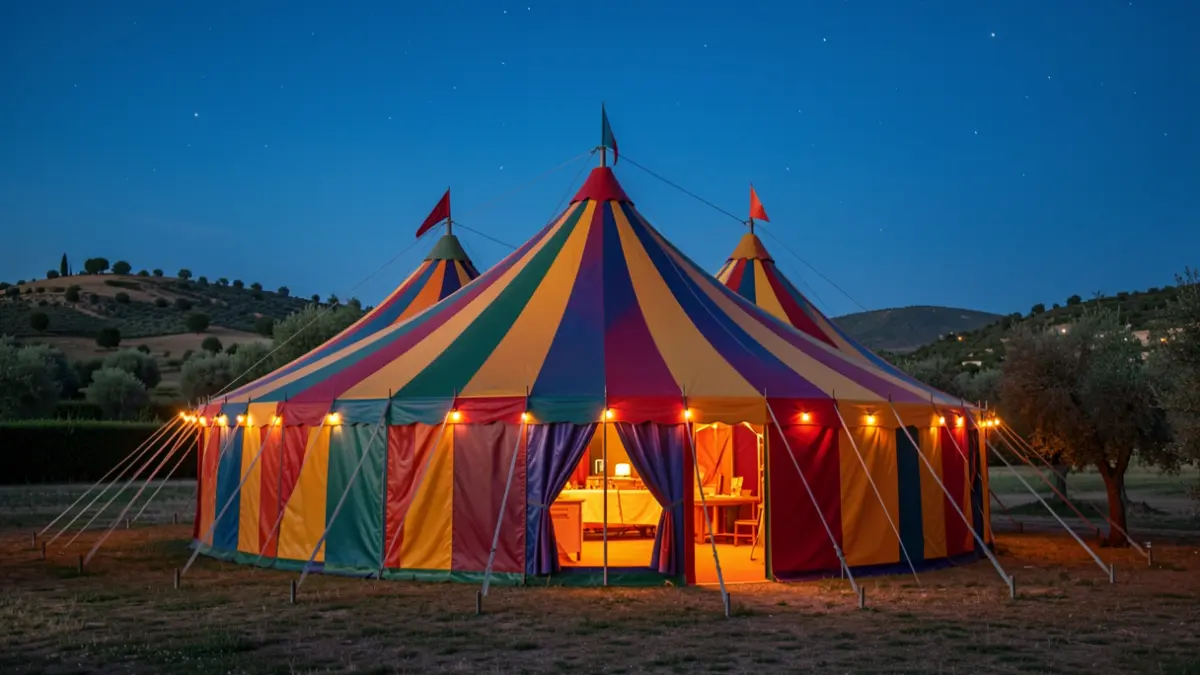
The grand tent of Cirque du Soleil has arrived in Malaga to present 'Kurios: Cabinet of Curiosities', a spectacle blending imagination, live music, humor, and challenging acrobatics with an aesthetic inspired by the era of Jules Verne. Beyond family enjoyment, the performance leaves the audience with unexpected reflections on existence.
One of the strengths of Cirque du Soleil lies in its ability to amaze without resorting to animals, relying on imagination, talent, music, and acrobats who defy physics. This approach aligns with the ban on circuses with animals in Malaga, contrasting with debates on other traditions like bullfighting.
The staging transports the audience to a parallel reality, evoking early 20th-century train stations, Verne's novels, and eccentric dreams, featuring elements like impossible locomotives, mad scientists, gramophones, and mechanical creatures. The music, far from being mere accompaniment, becomes a protagonist, with musicians and a singer interacting with the audience in surprising ways.
The dynamics of the music and the singer's appearances in various parts of the venue prompt thoughts on how life unfolds simultaneously in multiple places, often in unexpected ways. This idea is reinforced when observing the show through the eyes of a neurodivergent child, who, far from being overwhelmed, is fascinated by the visual and auditory stimuli, focusing on 'possibilities' rather than 'traumas'.
The concept of the 'invisible lion', a performance that elicits reactions to something unseen, leads to the reflection that humans often worry about, fall in love with, or fear 'invisible lions', basing much of our existence on imagination.
The show also stands out for its 'choreographed bombardment of beauty', designed to hold the viewer's attention without overwhelming them, and for the impressive performances of the acrobats, whose physical prowess seems to defy human evolution. The audience's enthusiastic ovation underscores the impact of these acts.
Beyond the vertigo and physical skill, the event's organization is remarkable. The entry, movement, and participation of over two thousand people demonstrate a perfectly synchronized operation. The recommendation to visit the restrooms before the show highlights the lack of dead time, evidencing the logistical complexity.
The main reflection from 'Kurios' is that the circus's magic, though visible to the audience, is never invisible. It is supported by hundreds of people: artists, musicians, technicians, and riggers, whose work is essential even if they don't receive applause. This traveling community functions as a single organism, a metaphor for society where diverse talents and abilities are necessary.
Leaving the tent, as the artists stop flying and the 'invisible lion' returns to its imaginary cage, the feeling remains that we spend too much time looking in the same direction. The circus, as a social metaphor, reminds us that sitting and observing can broaden our perception of reality.