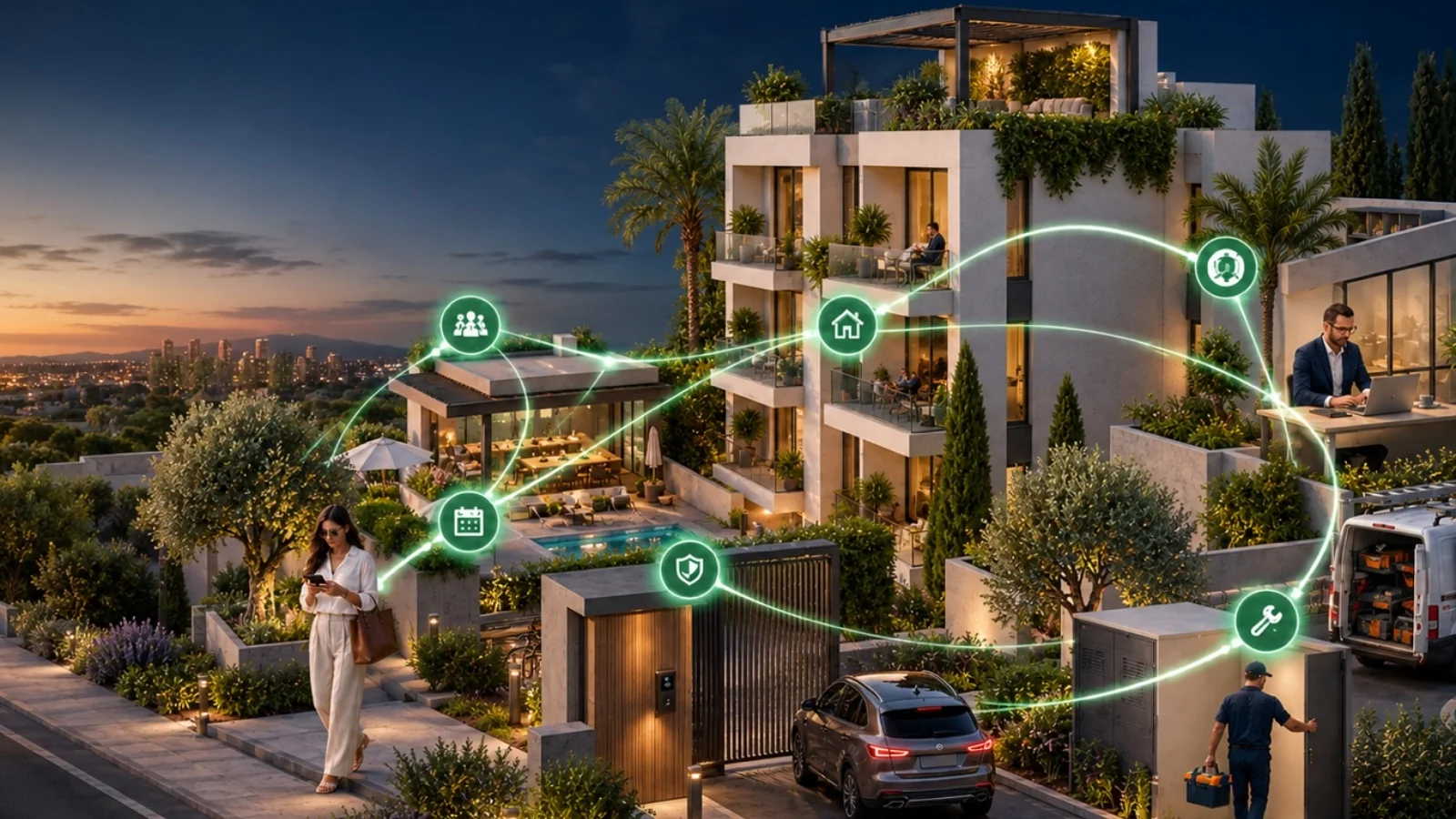
A homeowners' association is, in practice, a small organization. It has a budget, facilities, suppliers, contracts, employees, documents, legal obligations, and dozens, sometimes hundreds, of people who need to communicate and make decisions. However, much of its activity continues to be managed through a combination of emails, calls, spreadsheets, messaging groups, and documents stored in different places. The result is fragmented information that hinders coordination. A resident reports an incident by phone, the concierge relays it to the administrator, who contacts a maintenance company, and days later, no one knows for sure what its status is. A reservation is noted on a separate calendar, a key is handed over without record, and an important document gets lost in an email chain.
Onzane was born to organize that reality. The company, based in Tomares, Seville, has developed a technological platform that functions as a community's operating system: a common core on which residents, governing boards, property managers, employees, service companies, and suppliers work.
The concept of an operating system is not used here in a strictly computer science sense. It describes the function the platform serves within the community. Just as an operating system coordinates applications, users, devices, and data, Onzane connects the various elements involved in community management and allows each person to access only the tools they need.
Much More Than an App for Residents
In recent years, numerous applications have emerged to improve communication in homeowners' associations. Many of them allow for publishing notices, consulting documents, or booking a facility. These are useful functions, but they represent only a part of what happens daily in a building or development.
Onzane's proposal starts from a broader vision. It's not just about moving the notice board to a mobile phone, but about connecting communication with the processes that arise from it.
If a resident reports a breakdown, for example, the information shouldn't just remain a message. It should become a traceable incident, assigned to a responsible party, generate an action or work order, incorporate photos and evidence, and, where applicable, be linked to a supplier, a contract, a community asset, and an invoice.
The same applies to a reservation. The process might start in the resident's app, but it must also consider usage rules, schedules, capacity limits, potential penalties for no-shows, and, if the facility has a connected access system, the opening of the door during the authorized period.
This ability to link information and processes is what differentiates a platform from an isolated application. At Onzane, communication, reservations, incidents, payments, access, employees, suppliers, and professional management all work within the same environment.
The community thus stops accumulating independent tools and gains a common foundation. Each action generates useful information for subsequent ones, and each person can know what has happened, who has been involved, and what still needs to be done.
One Community, Different Experiences
Although all information is connected, not all users need to see the same things. A resident wants to check a notice, book a sports court, report a breakdown, or access a specific facility. An employee needs to organize tasks, log a package delivery, or document a patrol. An administrator must configure the community, manage permissions, and oversee multiple communities simultaneously. A supplier needs to receive requests, submit quotes, perform work, and provide evidence.
For this reason, Onzane is structured through specialized experiences that operate on a single technological core.
Residents use the Onzane app. From it, they can receive notices, consult documents, participate in surveys and votes, make reservations, report incidents, manage certain payments, and use digital credentials to access authorized areas.
Employees have Onzane Staff, an application focused on daily work within the community. Concierges, security, cleaning, or maintenance staff can receive tasks, manage packages, log patrols, handle incidents, control key custody, and record actions taken.
Administrators work through a web management panel. This space allows them to configure modules, import and export data, manage users and permissions, send communications, organize facilities, monitor operations, and manage different communities from a consolidated view.
Companies and professionals providing services have a specific panel for suppliers. From this environment, they can receive quote requests, formalize contracts, manage work, keep their documentation up-to-date, provide execution evidence, and process invoicing linked to each service.
The platform also includes a panel for rental managers. Agencies acting on behalf of owners can manage properties, stays, and tenants, coordinate check-ins and check-outs, and grant authorized permissions for using community spaces or digital keys during each stay.
Each profile, therefore, accesses a different experience, but all work on the same community. This architecture avoids duplication and reduces information gaps that occur when each party uses its own tool.
From Communication to Real Management
One of the common problems in communities is confusing communication with management. Reporting a breakdown is not the same as managing it. Sending a quote doesn't mean it's correctly linked to a need, a decision, and an execution. Publishing minutes doesn't guarantee that the agreed-upon actions will become tasks with assigned responsibilities and deadlines.
Onzane aims to complete these cycles. Information might start with a notice, an incident, a request, or a decision, but it must continue until the process is resolved.
Within the communication area, the platform allows distributing notices, holding conversations, sharing documents, and conducting surveys or votes. Content can be directed to the entire community or only to specific buildings, entrances, units, or user groups.
The availability of different languages also facilitates participation in communities with residents of various nationalities. The platform is prepared to function in twelve languages, reducing one of the most frequent barriers in residential developments and areas with a high international presence.
In daily management, communities can organize reservations, usage rules, procedures, payments, and budgets. Facilities no longer depend on separate calendars, and authorized individuals can check availability and applicable conditions through the app.
On an operational level, Onzane connects incidents, employees, packages, key custody, tasks, patrols, and maintenance. Each action can include dates, responsible parties, comments, photos, or documents, creating a history that remains accessible to the community.
From the Physical Building to its Digital History
A community's activity isn't limited to people and documents. It also revolves around physical elements: elevators, pumps, doors, pools, electrical panels, meters, fire extinguishers, sports facilities, or HVAC systems.
When information about these assets is scattered, it's difficult to know how much they cost, what maintenance they've received, which breakdowns are recurring, or which warranties are still valid. An intervention performed today might be disconnected from another that took place months earlier, even if both affect the same piece of equipment.
Onzane's new operational layer allows linking each asset to its location, documentation, maintenance plan, incidents, work orders, suppliers, evidence, and costs. The goal is for the building to construct its own operational history.
A pressure group pump, for example, can have a file with its serial number, photos, manuals, warranty, maintenance company, interventions performed, and accumulated cost. When a new breakdown occurs, the administrator doesn't have to reconstruct the information from scratch.
This view can evolve into what is known as an operational twin of the building. It doesn't have to be a three-dimensional representation. It can start with a reliable inventory, QR or NFC identifiers, organized documentation, maintenance plans, and connected sensors.
With sufficient data, the community can anticipate inspections, detect abnormal consumption, compare the cost of repairing versus replacing equipment, and make better-informed decisions.
Connected Access and Spaces
Access control is another area where digital management and the physical building converge. Many communities still use remotes, keys, and cards whose assignment is difficult to track. When a credential is lost or a person is no longer authorized, it's not always possible to react quickly.
Onzane allows managing people, vehicles, permissions, schedules, and spaces from the same platform. Residents can manage certain license plates through the app, while the community retains control over the applicable rules and authorizations.
The platform can integrate with locks, relays, sensors, license plate reading cameras, and RFID or NFC technologies. This allows for creating tailored solutions for entrances, garages, pools, sports facilities, technical rooms, or restricted areas.
Technology doesn't replace the community's decision-making; it helps execute it. A permission can be limited to a specific person, space, and time. A maintenance company can receive a temporary credential to perform a job. A short-term tenant can access only the facilities authorized by the owner and the community during their stay.
These integrations are part of the concept of community home automation: using third-party devices to connect certain physical actions with the rules, users, and processes already defined on the platform.
A Tool for Any Management Model
Not all communities are organized in the same way. Some rely primarily on their president or governing board. Others have their own staff, a service office, management, or maintenance teams. Many work with an external property manager, and others hire specialized companies to handle a significant portion of operations.
Onzane is designed to work with any of these models, as well as combinations thereof.
A community can contract the platform directly without changing its manager. The board can maintain an overall view, the professional firm can continue its work, employees can handle operations, and suppliers can collaborate on their respective processes.
The platform allows defining custom profiles and assigning permissions based on each person's responsibilities. Not all administrators need the same level of access, nor should all employees be able to view the same information.
This flexibility is particularly relevant when the board, service company, or property manager changes. In a model based on tools owned by each provider, part of the history might disappear with the change. With Onzane, data and processes remain linked to the community, regardless of who manages it at any given time.
The absence of vendor lock-in thus becomes an important argument. The community maintains the continuity of its information and can incorporate or replace collaborators without having to start over.
A New Way of Working for Property Managers
For professional firms, digitizing a community isn't just about offering an app to residents. The real value emerges when the application connects with the administration's internal work.
Onzane's multi-community dashboard provides a consolidated view of the portfolio, allowing for the identification of communities needing attention, open incidents, tasks with upcoming deadlines, and areas of high operational load.
Instead of reviewing separate channels, the firm can work from an organized inbox. Notices, documents, incidents, suppliers, and actions retain their connection to the corresponding community.
Adoption can be gradual. A manager can start with a single community and specific functions, such as communication, documents, or incidents. Later, they can incorporate reservations, employees, suppliers, access, payments, or other processes.
Onzane doesn't require immediate replacement of all existing software. Its Business API allows integrating the platform with external applications when the client needs to maintain some of their current systems or connect specific operations.
The company is also developing a professional and accounting suite that includes budgets, receipts, payments, delinquency tracking, reconciliation, invoicing, and document traceability. Its implementation is designed to be accompanied, allowing firms to progressively validate each process before centralizing a larger portion of their management.
Technology for Service Companies and Suppliers
The digitization of communities also opens opportunities for small and medium-sized businesses that work around them. Security, concierge, cleaning, maintenance, and auxiliary services are part of a market where operational capacity and transparency are increasingly important.
For these companies, Onzane can become a technological extension of their own offering. It not only facilitates the organization of employees, shifts, patrols, incidents, or evidence; it also allows them to show clients the work performed and maintain orderly communication.
A maintenance company can receive a task, assign it to a technician, log the start of the work, upload photos, and close the job with full traceability. A concierge service can organize packages, keys, patrols, and daily tasks. A security company can link services, access, and incidents.
Suppliers, on the other hand, can join for free to work with communities using Onzane. The usual workflow connects quote requests, contracts, execution, and invoicing.
When a maintenance contract exists, the supplier can receive tasks or incidents, execute the solution, add evidence, and, if non-included products or services were used, submit the corresponding additional invoice.
The platform also facilitates document validation. The community can verify if the company maintains valid insurance, certifications, preventive documentation, or other requirements before assigning a job.
This model seeks to professionalize the relationship without introducing opaque intermediaries. The community and its manager retain the decision on which supplier to hire, while the platform provides order, comparable information, and traceability.
Implementation as Part of the Product
One reason why some digitization processes fail is that the work is considered complete when software access is granted. However, a community doesn't adopt a new tool simply because it's available.
Data needs to be reviewed, functions configured, permissions set, administrators trained, employees informed, and residents invited. It's also necessary to monitor the activation rate and resolve doubts that arise during the initial weeks.
Therefore, implementation is part of Onzane's offering. The process begins by analyzing how the community operates and what problems it needs to solve. Then, data is imported and reviewed, modules are configured, and administrators and employees are trained.
Once the environment is prepared, residents are invited, and activation is supported. The platform can start with a limited set of functions and grow as the organization gains experience.
This approach reduces resistance to change and avoids implementing unnecessary processes. A small community might start with communication and incidents. A development with numerous common areas might prioritize reservations and access. A service company might focus on employees, tasks, and evidence.
The goal isn't to install the maximum number of modules possible, but to ensure the platform integrates into real activity and continues to be used after the initial novelty wears off.
A Platform Already Working in Hundreds of Communities
Onzane has connected over 700 communities, with more than 70,000 properties, 75,000 residents, and 750 managed facilities, according to figures published by the company.
These data illustrate the diversity of situations in which the platform can be used. A small building, a development with sports facilities, a community with its own staff, or a portfolio managed by a professional firm do not have the same needs.
The system's architecture allows activating only the necessary capabilities and expanding them over time. Thus, Onzane can support both direct contracting by a community and the progressive rollout by a property management firm or a service company.
From its headquarters in Seville, the company develops technology applicable to a widely spread sector, largely composed of professionals, freelancers, and small businesses. This makes the project a regional initiative with the capacity to operate in communities and organizations across different markets.
Growth doesn't solely depend on increasing user numbers. Onzane's strategy relies on connecting more and more processes and building an information base that is useful for decision-making.
The Future of the Connected Community
The platform's evolution points towards communities capable of better understanding their own activity. When assets, contracts, interventions, suppliers, invoices, consumption, and decisions are linked, it becomes possible to answer questions that previously required reviewing dozens of documents.
How much has it cost to maintain an elevator over the last few years? Which breakdowns are recurring in a facility? Which supplier responds fastest? Which contracts are nearing expiration? Which equipment concentrates the most incidents? How will the community's treasury evolve?
This information can serve as a basis for automating tasks, detecting anomalies, and generating recommendations. Artificial intelligence can help classify incidents, locate information within minutes or contracts, draft communications, and present to managers only those decisions requiring human judgment.
But the usefulness of this intelligence depends on the quality of the context. An isolated assistant can draft texts; a connected platform knows which community, building, unit, asset, contract, or incident each action refers to.
This is one of Onzane's main bets: building a technological structure that represents the reality of each community and allows linking people, spaces, assets, and processes.
Automation also doesn't mean eliminating supervision. Payments, legal decisions, final accounting, or sensitive communications must maintain approval mechanisms. The platform can prepare the work, highlight exceptions, and record who proposes, authorizes, and executes each action.
From the Managed Building to the Organized Community
Homeowners' associations have coexisted for years with fragmented tools because no platform existed to represent their full complexity. Applications solved one function, professional software another, and suppliers continued to work through their own channels.
Onzane's approach is to connect these pieces without forcing everyone to use the same interface. The community retains a common core, while each person has an experience tailored to their role.
For the resident, this means knowing where to find information and being able to participate with less friction. For the board, it means maintaining control and data continuity. For the manager, it means reducing scattered tasks and working with a multi-community view. For employees, it means receiving clear instructions and documenting their activity. For suppliers, it means collaborating through traceable processes.
The relationship with the building itself also changes. Facilities cease to be anonymous elements and begin to have a history, documentation, associated costs, and maintenance. Access can be adapted to specific permissions, and actions generate evidence that remains available.
Talking about an operating system for communities summarizes this transformation. It's not just an app or a collection of features. It's a common infrastructure for organizing the life, management, and operation of a shared environment.
At a time when communities face greater demands for transparency, maintenance, efficiency, security, and participation, having connected information can make the difference between merely reacting to problems or managing with a comprehensive vision.
Onzane proposes precisely that change: that the community stop depending on scattered conversations and documents and start functioning as a connected organization, capable of preserving its knowledge, coordinating those who work within it, and progressively improving.