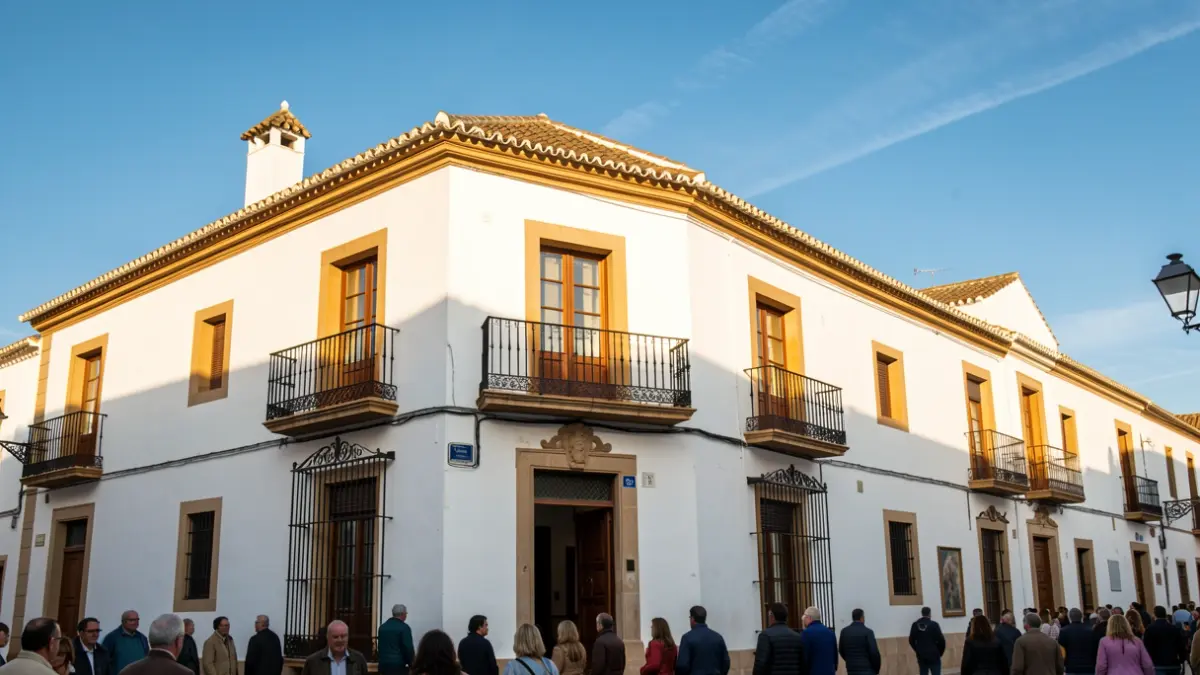
The scientist from Malaga, with deep family and personal ties to the municipality, will receive the honor at an official ceremony next December. The appointment was unanimously approved at the municipal plenary session on June 23rd.
Ana Mata highlighted the distinguished career of Huesa, who is currently conducting postdoctoral research at Massachusetts General Hospital, affiliated with Harvard Medical School, focusing on liver cancer treatments. His work has been recognized with numerous awards, including a recent one from the US government through the National Institutes of Health and the National Cancer Institute. The reception was also attended by the first deputy mayor, Juan Carlos Cuevas.
The mayor described Huesa as a "perfect example for the youth of Mijas," emphasizing that "with work, effort, and vocation, the highest goals can be achieved in any field, and contribute to society to make it better every day."
For his part, Huesa expressed his gratitude for the honor, acknowledging the responsibility it entails and the importance of his roots: "I am who I am because of the past I have had, and that past makes no sense if we don't talk about Mijas, my parents, my grandparents, because I was here every weekend and this is my childhood place," he stated.
The researcher committed to actively participating in the municipality and organizing events for the youth of Mijas to promote research and science, planned for December.
Huesa added that "Mijas perfectly summarizes who I am, it is truly beautiful to remember the role of my grandparents and the effort of my parents, and to recall the environment of affection they created for me in Mijas."
Carlos Huesa's research in the US has been awarded the ‘Pathway to Independence Award’ by the American government, which provides up to five years of funding for relevant projects at the National Institutes of Health. His work focuses on an innovative therapy for liver cancer involving the injection of radioactive microspheres into the hepatic artery, aiming to cut off tumor supply and destroy cancer cells locally.
Huesa pursued higher education at the University of Malaga (Health Engineering) and obtained his doctorate in Medical Physics at the University of Navarra. He has resided in Boston since late 2022, where he received a scholarship from the American Cancer Society in 2024. Other accolades include the ‘Best in Physics’ award from the American Association Of Physicists in Medicine and the Flag of Andalusia for Research, Science, and Health in 2025.