The new method, led by professor Juan José Moyano, allows for the analysis of wall thickness, layout, and inclination, as well as the estimation of their original height, overcoming the difficulty of reconstructing degraded or collapsed structures. The findings are published in the journal Buildings.
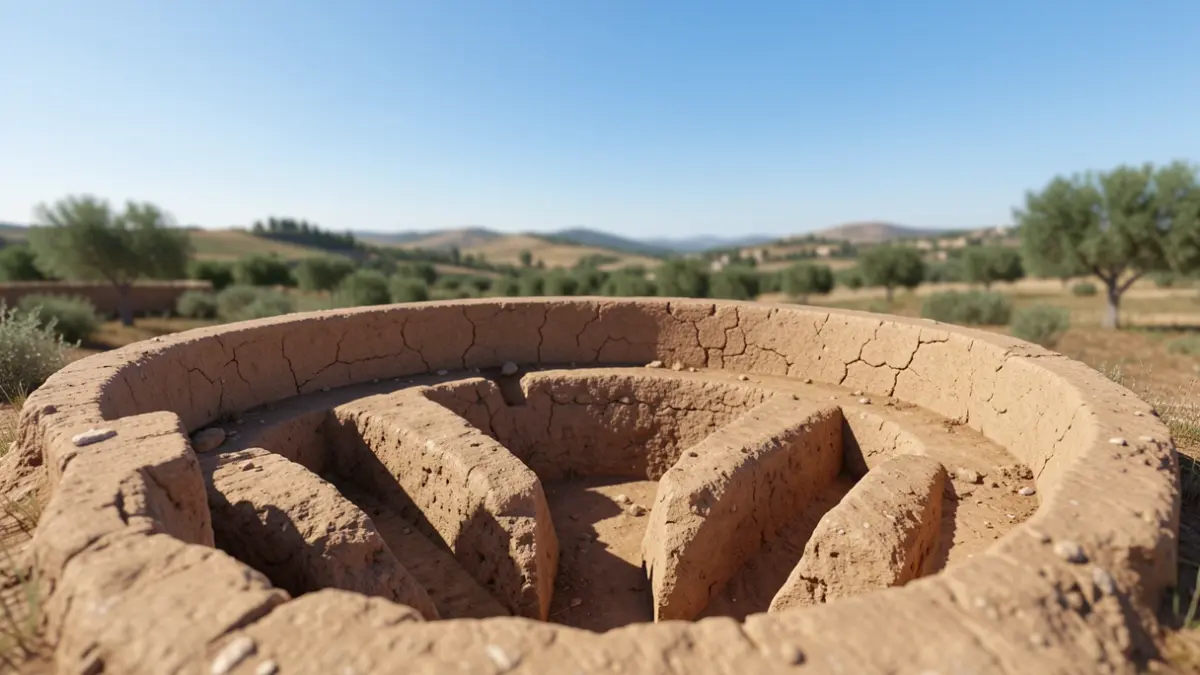
The methodology has been applied to a prehistoric structure documented at the site of the Municipal Library of Valencina de la Concepción, where remains of adobe walls, nearly four meters high and arranged in a semicircle with V-shaped trenches, were excavated between 2018 and 2024.
Using terrestrial laser scanning (TLS) and recording 5.12 million points, the system calculates thickness, identifies changes in direction, and analyzes inclination. Maximum height is estimated using a simplified equilibrium model.
The procedure, named Best-Fit Model Profile (BFMP), generates a reference geometric profile for comparing wall sections, measuring deviations, and assessing reconstruction uncertainty. The results are integrated into 3D digital models and BIM environments for reproducible archaeological heritage documentation.
Based on these findings, the team has created an artistic recreation of the settlement that may have existed there approximately 4,900 years ago, proposing a semicircular arrangement of adobe walls and deep trenches, a unique construction for the Copper Age in the Iberian Peninsula.