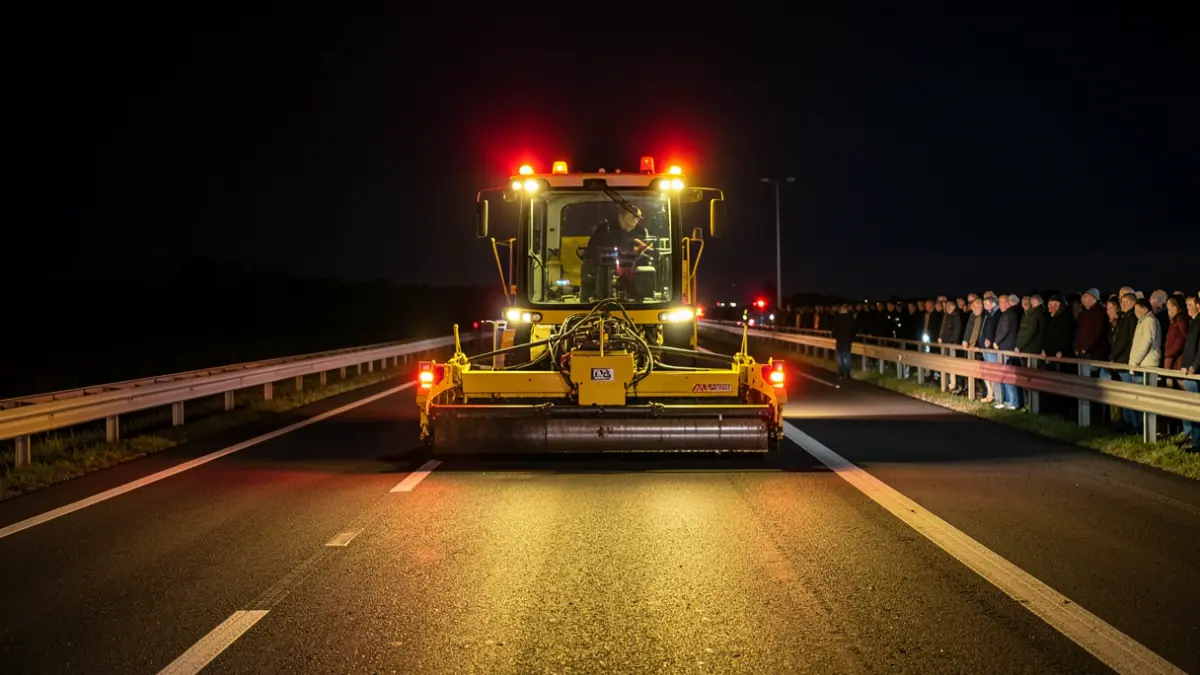
The work is being carried out during nighttime hours to ensure the safety of the workers and minimize traffic disruptions during peak circulation times.
The first section, covering kilometers 141 to 151, has already been completed. Work on the second section, from kilometer 154 to 176, will take place between the last week of August and the first week of September.
The Minister of Public Works and Mobility, Mario Muñoz-Atanet, stated that the Andalusian government is using this plan to continue the comprehensive reform of the A-92, recalling that nearly 90 kilometers of this highway have been renovated in recent years.
Muñoz-Atanet highlighted the significance of this new plan, which will cover 126 kilometers of the A-92 across the provinces of Almería, Granada, Málaga, and Sevilla. "We cannot forget that 97% of travel is by road, so taking care of our roads means taking care of mobility, safety, the economy, and territorial cohesion in Andalusia," he added.
The Extraordinary Asphalting Plan represents the largest investment in road surface improvements in the last 20 years, with 151.5 million euros allocated to Andalucía. Of this amount, 17.5 million euros are reserved for the province of Málaga, where work will be carried out on fifteen roads. Recently, ten kilometers of the Guadalhorce Highway (A-357) were also completed, also during nighttime hours.
The interventions on the A-92 in Málaga are focused on the sections technicians have identified as "most deteriorated." Work began earlier this month near kilometer 151, close to Antequera, and will comprehensively address seven kilometers of the highway between Mollina, Antequera, and Archidona.
The Junta de Andalucía's plan aims to work on 1,000 kilometers of 137 regional roads, ensuring adequate levels of safety and comfort for road users, as well as improving the structural characteristics of the most deteriorated sections detected across the eight Andalusian provinces. A prior analysis of the road network's condition has been conducted to ensure proper execution of the surface layers.
The planned actions include repairing potholes and soft spots; milling and replacing the pavement; restoring the subgrade and lower layers; laying bituminous mixtures; sealing pavements; repainting horizontal signage; replacing or raising containment elements; replacing beaconing elements; replacing expansion joints on structures; and replacing coils at gauging stations.