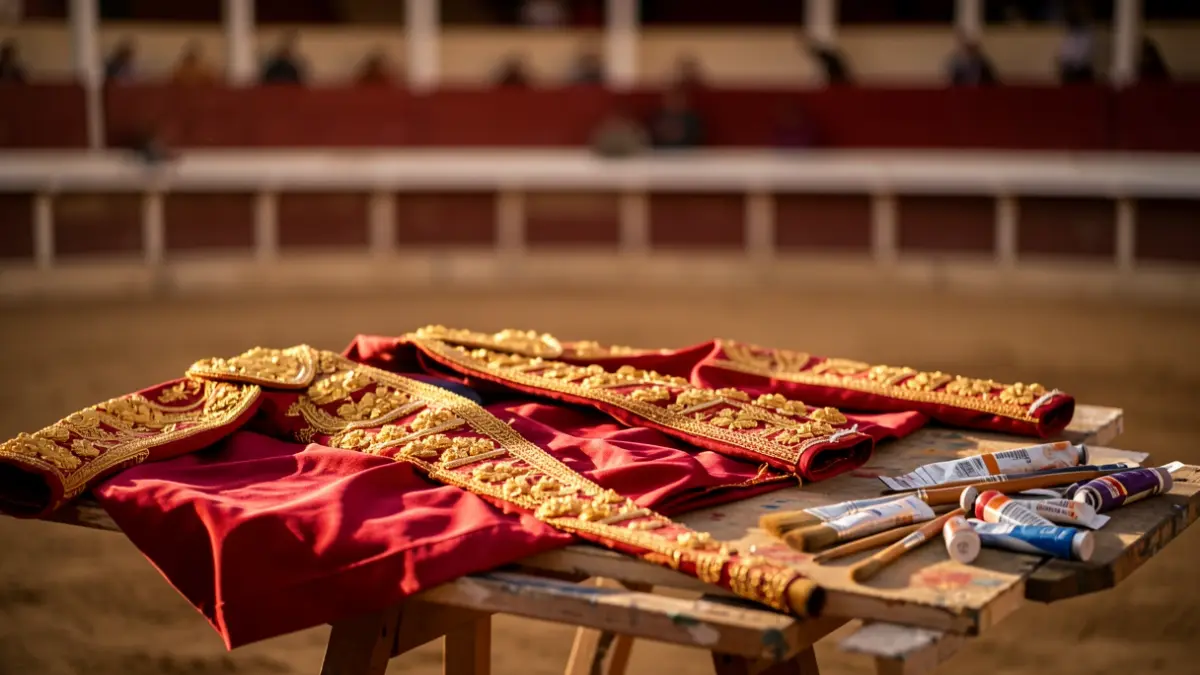
César López Acacio, born in Almería in 1978, has managed to balance his profession as a taxi driver with his two great passions: bullfighting and painting. Living in the La Esperanza neighborhood, close to the Bullring, his taurine passion has deep roots. After inheriting his father's taxi license, he has found a new form of expression in pictorial art, trading the killing tools for paintbrushes.
His career in the bullfighting world began at 16, training at the Almería Bullfighting School under the guidance of masters like Pepe Plaza. After fighting numerous bull calves, he took his 'alternative' (full bullfighter status) in Vera in 2002, sharing the bill with figures such as Manuel Caballero and Morante de la Puebla. For years, he toured bullrings in Spain, Peru, Colombia, Mexico, Portugal, and France before deciding to retire and become a taxi driver, a profession that has provided him with stability.
Despite his retirement from the ring, López remained linked to the bullfighting world, teaching at the Bullfighting School for 11 years. However, the pandemic led him to focus entirely on his work as a taxi driver. It was then that, seeking a creative activity away from screens, he began painting three years ago. The sensitivity developed in bullfighting has found its outlet in painting, allowing him to feel in his "comfort zone."
“"My personal tribute to a legendary bullfighter who deserves to be on the poster for a festival like Roquetas de Mar, where all the bullfighting stars want to be."
His most recent work is the poster for the Roquetas de Mar Bullfighting Fair, a tribute to the master Rafael de Paula, who passed away this year and whom López considers a benchmark. Although he has undertaken personal commissions, his main source of inspiration is the world of bullfighting, capturing the expression, gazes, and atmosphere of bullfighters and taurine scenes. He describes painting as a process of materializing ideas after long hours of hard work.
Regarding criticism of bullfighting, López dismisses it, highlighting the recovery of the "past bullfighting culture" thanks to figures like Morante de la Puebla, Juan Ortega, and Pablo Aguado, as well as bullfighters from previous generations such as El Juli and Enrique Ponce.