
This service, provided from Monday to Friday, is essential for residents of the province of Jaén, especially those affected by allergies. The information will be published on Facebook (Hospital Universitario de Jaén), Instagram (@hospitaluniversitariodejaen), and X (@HospitalJaen).
Specialists from the hospital's Allergy Unit measure the concentrations of various types of pollen, particularly olive and grass pollens, which typically reach the highest levels in the region. The availability of this daily information allows allergic individuals to anticipate high-risk days, implement preventive measures, and adjust their treatments, thereby helping to mitigate symptom intensity and prevent respiratory complications.
“"The forecast this year, which has been very rainy, is that pollen levels will be higher than last year, so it emphasizes the importance of taking medication for diagnosed patients, so that, once the peak pollen levels are reached, they can respond as best as possible and avoid greater affectation."
To carry out these measurements, Jaén University Hospital has a pollen trap installed on the ninth floor of the Maternity and Children's Hospital. This device uses the ‘Hirst’ method, which sucks in particles based on the impact principle. This system is the standard employed by all sampling stations affiliated with the Spanish Aerobiology Network (REA) and by working groups of the European Aeroallergen Network (EAN).
The trap consists of three units: an impact unit, a weather vane, and a vacuum pump. The impact unit has an inlet and a circular drum where particles adhere, connected to a clock and rotating at two millimeters per hour. It also has a tape impregnated with an adhesive substance to ensure that sucked-in particles stick. The weather vane protects the impact unit and keeps the inlet facing the prevailing winds to maximize particle capture efficiency. The vacuum pump ensures a constant air suction volume of 10 liters per minute.
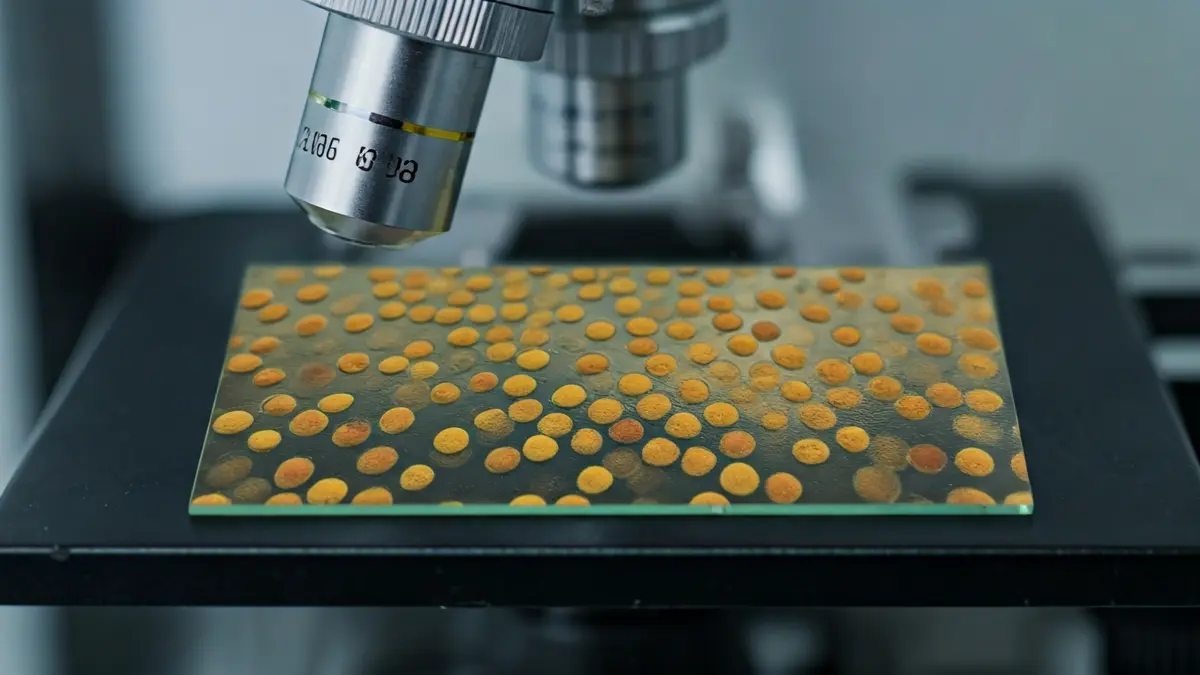
Once the pollens adhere to the tape, it is stained with fuchsine and examined under a microscope. Using a mathematical formula, the average number of pollen grains per cubic meter of air is calculated, providing precise data for the daily forecast.